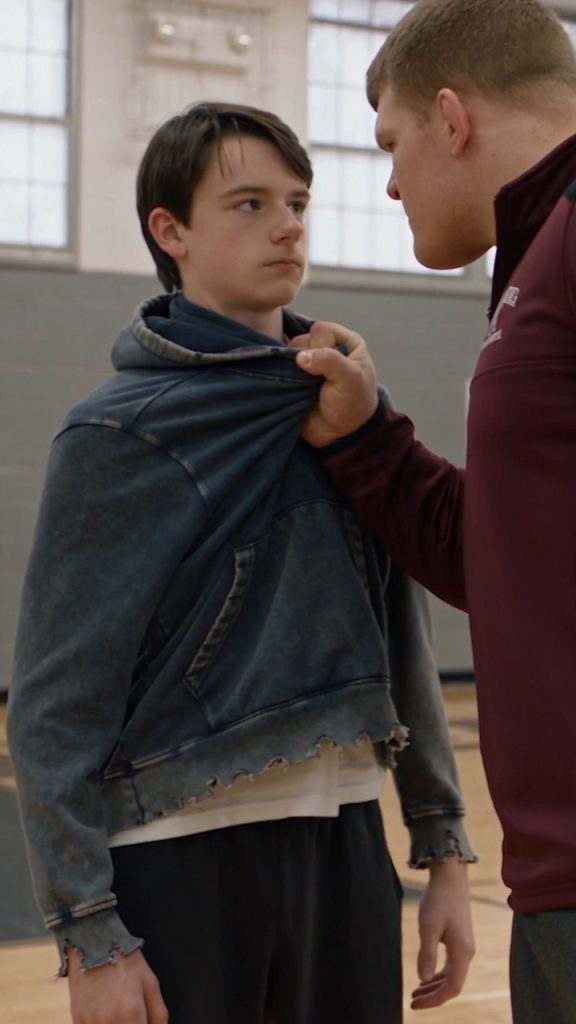
The administrator didn’t give me a list of every student’s private sanction, and by then I no longer wanted one. I knew enough to understand that the school had not simply let a captain take the blame for everyone while the rest walked away unchanged. It had also not called eight boys equally responsible for a punch no one could prove they anticipated.
“What about Coach Miller?” I asked.
Ruiz looked at the athletic administrator before answering. “The school’s review found a lapse in supervision. Coach Miller has received a formal warning, additional supervision expectations and training, with oversight from the athletics administration. The open gym period will have assigned active supervision, and staff are expected to respond immediately to students blocking access or escalating a confrontation.”
I thought of the blue wheeled equipment box and the little tune Coach had whistled while my collar stretched against my throat. A warning could not reach backward and make him look up in time. But the next student who entered that gym might not have to gamble on whether an adult was watching.
Mom asked for the findings concerning me in writing. Ruiz handed us a letter summarizing the decision and said a copy would be retained in the appropriate school file. The letter said there was no disciplinary penalty. It also confirmed that my scholarship remained unchanged; there was no action against my academic standing or aid as a result of the incident.
I read that sentence three times. I hadn’t admitted to Mom quite how deeply I feared losing the school. I could see now that she had known anyway.
The final part of the meeting was about things that sounded smaller than captain titles and formal findings: which hallway I would use, whether I could return to after-school activities, whom I could contact if I felt unsafe, and what to do if anyone tried to pressure me about the investigation. The interim arrangements would become a clear safety plan for as long as they were needed. Staff would not ask me to avoid the gym indefinitely to make it easier for other people to manage Brody.
“Can I use the gym during open period?” I asked.
“Yes,” Ruiz said. “With active supervision, as with the other students. You’re entitled to use the school facilities under the same ordinary rules.”
The words were plain. That was what made them matter. I wasn’t being given a special privilege in exchange for suffering. I was being told that I still belonged where I had belonged before anyone tried to drag me out of it.
After the meeting, Mom and I walked slowly to the courtyard. The rain had stopped again. She tucked the decision letter into her folder and asked if I wanted to get something to eat before she went back to work.
“I think I just want to go to class,” I said.
She smiled a little. “That might be the strangest thing you’ve asked for all week.”
“It’s a strange week.”
She took my hand for a second, then let go when students came around the corner. I knew she wasn’t embarrassed. She was giving me room to decide how I wanted to be seen. I followed the path toward the academic building with my backpack on one shoulder and the collar of my old hoodie resting loosely against my neck.
On the way back toward class I paused at the plaque outside the scholarship office. It listed the values the academy liked to put in print: curiosity, commitment, community. I’d walked past the words for years without thinking much about them. I used to believe being admitted on aid meant I had to be twice as careful as everybody else, because one wrong move would prove I hadn’t really belonged. Brody had known enough to use that fear when he called me a charity case.
I had not earned my place by never being afraid or never making a defensive choice. I had earned it through schoolwork, applications, ordinary long hours at a table Mom and I shared in our kitchen. Even if the review had reached a harder conclusion, it would not have made the mockery right. The letter in Mom’s folder mattered because it kept a false allegation from becoming a penalty, not because it granted me a worth I’d lacked before.
I sent Mom a message asking her to keep the decision letter with our school records. She wrote back that she’d already made a copy and that the original would stay in her folder. Then she sent a second message: You can concentrate on your next math test now, please. I laughed in the middle of the walkway. She had found a way to sound relieved without making me feel like a fragile object.
A student passed by and gave me a curious look. I didn’t explain why I was smiling. It was one of the first things all week that belonged only to me.
The news did not arrive at school as one neat announcement. The administration did not put students’ names and sanctions on a public board. People noticed that Brody was no longer listed as captain for upcoming team activities. They saw adults stationed where they should have been. They heard fragments from students who chose to discuss their own involvement. Some still repeated the edited clip, though fewer people treated it as the entire story once Owen’s original had been considered in the school process.
A boy from chemistry asked me if I was going to post a statement online. I said no. Another asked whether I was glad Brody had been punished. I told him I was glad I didn’t have to be afraid of seeing Brody by the locker-room doors again. He seemed disappointed by the answer. I suspected he had been hoping for the kind of speech people liked to forward with the videos.





