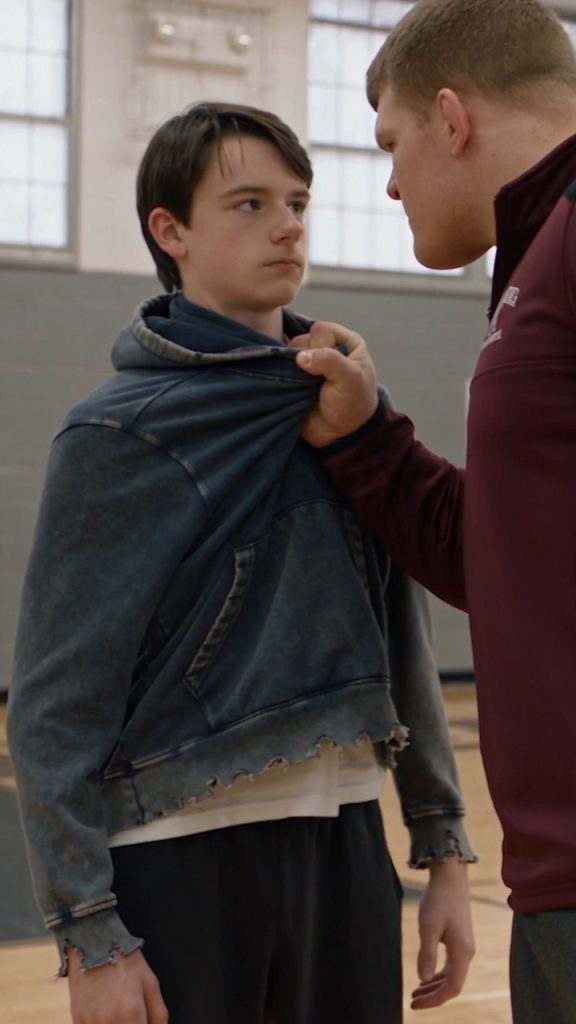
Ruiz wrote something. “We’ll take each account separately. I’m not deciding responsibility in the gym. The students who were at the doors need to wait with staff. Those who recorded may be asked to share original files voluntarily. No one should upload or send videos while we’re sorting this out.”
I wondered how many had already hit send.
She turned to me. “Noah, can you tell me whether there’s an immediate safety concern if you stay on campus for another half hour?”
“Brody told Marcus to shut up after Marcus explained what happened,” I said. The words came out thinner than I wanted. “I don’t want to be left alone with him.”
“You won’t be.” She spoke without looking toward Brody for permission. “You can wait in the counseling office with another adult present. We’ll contact your family.”
She asked if I had physically hit Brody. I said no. She asked whether I’d put my hands on him. I said yes, when he rushed at me a second time. She wrote both answers down. They did not sound contradictory when I said them plainly, but I could feel how someone might twist them apart later.
At the gym entry I stopped and looked back. It would have been nice to find a familiar face among the watching students. Sarah was standing near the bottom of the bleachers talking quietly to a staff member. Owen was still holding his phone. Marcus sat by the locker-room doors with his elbows on his knees, no longer surrounded but not exactly free either.
I had seen him in the cafeteria plenty of times, usually beside teammates who filled all the seats at once. I couldn’t remember a single time we’d spoken. Today he’d said one sentence that no one else had been willing to say. I wondered what it had cost him already.
The nurse checked the soreness around my collar and asked me about my shoulders, neck, and head. There was no obvious injury requiring more than rest and observation, she said, but I should report any symptoms that developed. She spoke carefully, like an adult who understood that students often said they were fine when they meant they wanted to go home. I thanked her and let her write down what she found.
From the counseling office, the whole school looked unchanged. Gray light lay across the courtyard. A maintenance cart rattled outside. Somebody laughed in the hallway at a joke I couldn’t hear. It seemed impossible that ordinary life could continue so efficiently when I still felt Brody’s grip at my throat.
A counselor offered water. I took it. When my hand shook against the paper cup, she didn’t comment. She asked if I wanted someone to sit with me or give me space in the open office. I asked for a little space. She left the door open and worked at the adjacent desk.
A small boy from the middle school passed the counseling-office doorway with a violin case almost as large as his torso. He slowed when he saw me. I recognized the way his eyes flicked to the adult at the desk, then to my hoodie, as if he had heard some version of the gym story and was trying to decide whether I was someone he should avoid. I looked down at my water instead of asking him. He went on toward the music wing.
It occurred to me that I’d been doing a version of that looking since seventh grade, trying to read whether the older kids were safe before I entered a room. Hawthorne Ridge’s buildings were polished, its brochures showed smiling students in careful groups, and the cafeteria served soup in real bowls. None of that had ever prevented a boy from making the scholarship sound like an offense. I wanted someone to tell the younger student that he wouldn’t have to learn my habits. I also knew I had no right to promise him that.
I took the pen Ruiz had left and wrote my name at the top of the form in larger letters than usual. It was a small way of refusing to shrink into the old nickname. Whatever else happened, the school report would be about Noah Ellis, a person with an account of his own, not the character Brody had invented for the audience.
I tried to reconstruct the sequence before anyone asked me to recount it in detail: Brody’s right hand in the collar. The doors blocked. The demand to kneel. One bow. First rush and stumble. Second rush and the floor. Six feet back. The accusation. Owen’s phone. Sarah coming down. Marcus speaking.
It was such a short list for something that had rearranged the afternoon.
Twenty minutes later Ruiz came to the doorway. She had already spoken briefly to several students, she said, and would need longer interviews over the next days. She wanted to know whether I could write a timeline while the memory was fresh. I said I could. She also told me that Brody had made a statement saying I’d assaulted him.
I thought of the faces from the bleachers, all those tiny rectangles pointed at us, and I felt the floor shift inside my chest again.
“Is that what the school believes?” I asked.
“It’s what he is alleging,” she said. “It’s not a finding.”
I should have been reassured. Instead, I heard Brody’s voice in my head: He went after me. He had managed to say it before anyone else could tell the story. He had already begun to shape the first sentence other people would remember.
At Hawthorne Ridge, people talked about honor at assemblies. There were posters about integrity in every classroom. But I’d learned that the first version of an event often traveled fastest when it came from someone everyone already knew. Brody was a captain. I was the boy at the back table in the faded hoodie. Even after the gym had gone silent, those facts hadn’t changed.





