I didn’t have one. I had a decision letter, a safe route through the building, and the possibility of eating lunch without wondering whether somebody would demand an apology for sitting down. Those things were enough to be getting on with.
On Thursday Sarah found me near the back table and asked how I was doing. I told her the findings about me had been made and that I wasn’t facing discipline. She exhaled as if she’d been holding the air in for days.
“I gave them my statement because I wanted them to know I didn’t ask for any of it,” she said. “But I’m glad it helped tell what happened to you too.”
“I’m glad you said it.”
She sat across from me and began describing a history assignment she’d been putting off. It was an ordinary conversation, the sort we’d never managed to have without Brody turning it into a story about someone else. I liked that she wasn’t asking what the bow meant or whether I’d ever been afraid. She treated me like a person who could be bored by a difficult essay.
Owen arrived halfway through lunch and put his book beside his tray. He told us he had declined another request to send the full video to a student group. Ruiz had explained the school’s concerns about circulating recordings of minors and had asked students to stop sharing material from the incident. Owen had kept his original and had cooperated with the review. He didn’t have to give up his phone, and he didn’t have to turn the recording into a public performance.
“I still wish I’d called for help,” he said.
“Next time something like that starts,” Sarah replied, “we can all do that before anybody has to ask.”
No one at the table claimed we’d been brave from the beginning. I liked that better than the assemblies I’d endured for years. A plan for doing something different was worth more than a flattering account of what we’d already done.
Marcus came to the table on Friday. He stood there for a few seconds with his lunch tray and the anxious expression of someone expecting an empty chair to be declared unavailable. I moved my notebook from the seat beside me.
“There’s room,” I said.
He sat down carefully. The other students kept talking, and after a while he joined in, asking Owen about the English reading. No one stood up to make a grand announcement about courage. Nobody needed to. The fact that he could sit at the table and talk about homework told me something about what had changed.
Before lunch ended, Marcus asked if we could walk to the lockers together. In the hallway he told me he had decided to stay on the wrestling team for now, though he would pay attention to how things were handled. He didn’t want his decision to be driven by fear of Brody.
“I felt sick before the interview,” he said. “I almost changed the paper.”
“But you didn’t.”
“No.” He paused. “I told Ruiz what he said before the gym thing happened. I told her I stood in front of the doors because he told me to. I also said I didn’t know he was going to swing. She asked questions. I answered them.”
“That’s what she told me the review considered.”
Marcus nodded. “I figured you should hear it from me, too.”
“You didn’t owe me that.”
“I know.” He smiled faintly. “That’s why I wanted to.”
After school I walked toward the gym. The corridor had the same smell of floor polish and damp jackets as it always did. I could hear the bounce of a ball and the sound of sneakers on hardwood. The locker-room doors were visible at the far end, and for one moment my chest tightened at the sight of them.
There was no wall of JV wrestlers in front of the doors. The passage was clear. A staff member stood near the entrance checking who was using the space, and Coach Miller was on the floor with another adult, supervising a group of students running simple warm-up exercises. His black phone was nowhere in his hands. The blue equipment box rested against the back wall, exactly where it belonged: a box, not a place to disappear from the room.
Coach looked up when I entered. He didn’t wave me over or ask me to discuss Monday again. He nodded, returned his attention to the group, and called a reminder about leaving the doorways clear. I was grateful not to be made into an example in front of everyone.
A younger student came through the locker-room doors carrying a mesh bag of practice balls. Two teammates moved out of his way without being asked. The passage stayed open after he went by. I caught myself watching that ordinary exchange as if it were an important event, and maybe to me it was. A week earlier, eight people had stood in nearly that same stretch of floor and made leaving seem impossible. Today the space worked the way it was supposed to work: a doorway that belonged to everybody who needed to pass through it.
The student set down the bag, and a ball escaped. It rolled toward me. I trapped it gently under my sneaker and passed it back. He thanked me and returned to his friends. He didn’t ask about the video or mention Brody. I wasn’t required to explain anything before I could help him. I was simply another person in the gym, useful for a second and then free to carry on with my own afternoon.
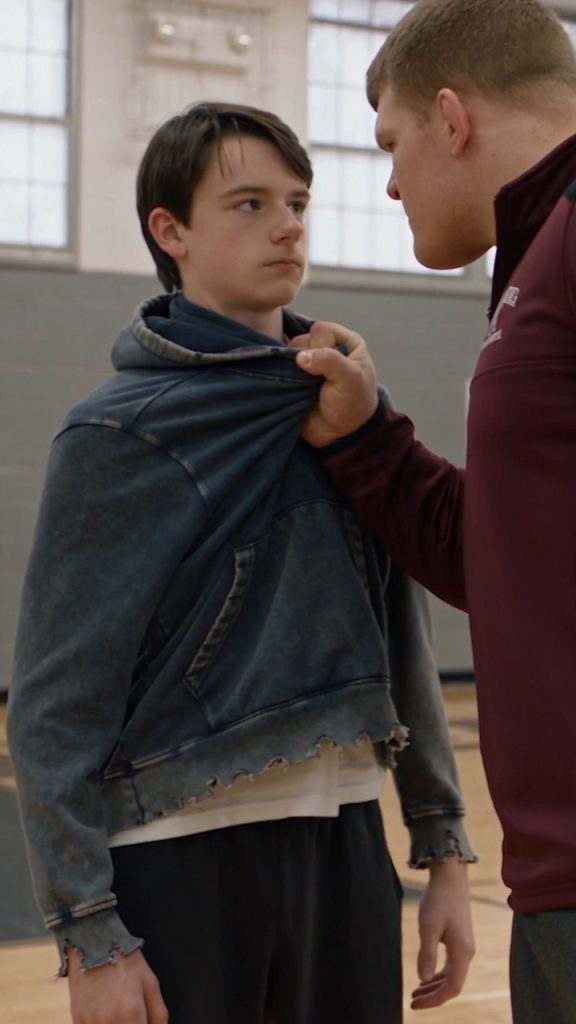
I walked to the east bleachers. The metal was cold beneath my fingertips. For a second I could still see Brody gripping my hoodie, could still hear the old chant rising behind him. I knew memory wouldn’t obey a school decision just because it had been written on official paper. There might be days when the sound of a sneaker squeaking made my heart race. There might be days when I wanted to sit close to an exit or leave early. Those reactions would not make the outcome less real.





