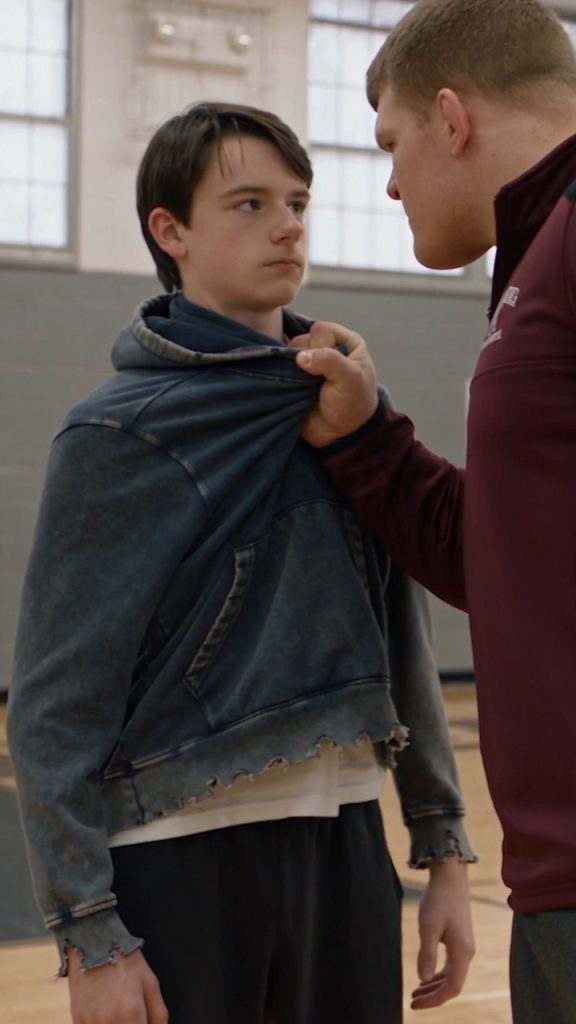
It came through a class group chat from someone who hadn’t been in the gym. The video began with Brody already falling. It was only a few seconds long. There I was, hands near his arm, moving him toward the hardwood; there he was, landing heavily, before the picture froze and a new message appeared below it: Scholarship kid finally snapped.
I watched it twice. The worst part wasn’t that it looked violent. The worst part was that I knew the people who hadn’t seen the beginning could watch it and believe they had seen enough.
My thumb hovered over the reply field. I could have typed the whole story right there, among the jokes and reaction emojis. I could have argued with every person who repeated Brody’s words. I could have sent back the exact insult he’d used about my scholarship and dared them to defend it.
Instead I took a screenshot showing where the clip had appeared, then put the phone face down. I didn’t know who had made that particular cut. It might have come from anyone recording on the bleachers. It might even have been copied from a longer video without the original filmer’s permission. None of that changed what was missing.
Mom saw my expression. I showed her the clip.
“What came before that?” she asked.
“Everything,” I said.
I sent Ruiz a short message through the school’s approved parent-and-student channel: A partial recording is circulating. It starts during the second charge and omits Brody grabbing my hoodie and attacking first. Please request original files, not forwarded copies. I can provide the message I received.
It was strange how much courage pressing send required when nobody was physically in front of me.
On Tuesday morning, Hawthorne Ridge looked as it always did. Students with half-zipped backpacks crowded the walkway. The windows of the science building reflected a pale sky. The school had not printed a notice announcing that I was innocent or guilty, and I hadn’t expected one. Still, I found myself searching every face for a sign that people had seen the clip.
Some had. A pair of freshmen stopped talking when I passed. A senior in the hall made the motion of dropping a wrestling opponent and laughed into his sleeve. I wanted to tell him I hadn’t wanted to put anybody on the floor. I kept walking because his opinion was not worth a new confrontation.
The first adult I saw near my locker was the morning hall supervisor. Ruiz had arranged for someone to watch the intersection by the gym corridor, and Brody was told to use a different route while the review was pending. It made the building feel both safer and stranger. I hadn’t realized until then how much work adults sometimes had to do to establish conditions other students took for granted.
In English, Owen arrived just before the bell and slid into his seat two rows ahead of mine. I waited until our teacher had handed out the reading assignment, then asked quietly if he’d be willing to speak to Ruiz about his video.
He stared at the margin of his notebook. “People keep asking me for the full thing.”
“I’m not asking you to send it to me.”
“That isn’t what I meant.” He lowered his voice. “If I give it to the school, everybody will think I’m picking a side.”
“It’s your choice,” I said. “But what people are sharing leaves out the beginning.”
He rubbed his eyes. “I started recording because Brody already had you by the collar. I thought he was going to make you do something embarrassing. I should’ve called Coach instead.”
The bell rang before I could answer. I didn’t want to tell Owen his regret was enough, because it wasn’t. But I also didn’t want to make him feel that providing one recording could erase every choice we’d all made in the gym. When he turned back to his work, I wrote a question mark beside his name on my timeline. I wasn’t certain whether he’d help.
At lunch, I returned to the back table. I chose it because it was where I normally sat with my lunch and math notes, not because I was trying to prove something. There were plenty of empty chairs. For a moment I thought about taking my food outside instead. It was cold, and I was tired of making decisions around Brody even when he wasn’t there.
Sarah appeared with a tray and stopped an arm’s length away. “Can I sit?”
I shrugged toward the nearest chair. “Sure.”
She set her tray down carefully. A few people at neighboring tables looked over, then pretended not to. Sarah had been in two of my classes that year, and we’d spoken about assignments and a group presentation. She wasn’t somebody I had spent afternoons with. That made what she said next harder to predict.
“I didn’t ask Brody to do anything,” she said.
“I know.”
“You don’t, though. Not from me.” She looked down at her sandwich. “We were at the back table last week because there weren’t seats near the windows. You looked over when the bell rang. He made it into something else. I told him there wasn’t anything to discuss.”
“Were you two—” I started, then stopped. I wasn’t entitled to ask about her relationships just because Brody had dragged her name into what he’d done.
“It’s not the point,” she said, not unkindly. “Whether he liked me or thought he had to speak for me, he didn’t ask. And I never told him you had done anything wrong.”
She had seen the grip, she said, and had watched Brody lunge the first time and then again. From her bleacher seat she couldn’t hear every word. She had not heard whatever Brody said to the JV wrestlers before the confrontation. When she moved down two rows, she’d been trying to get close enough for him to hear her say stop.





