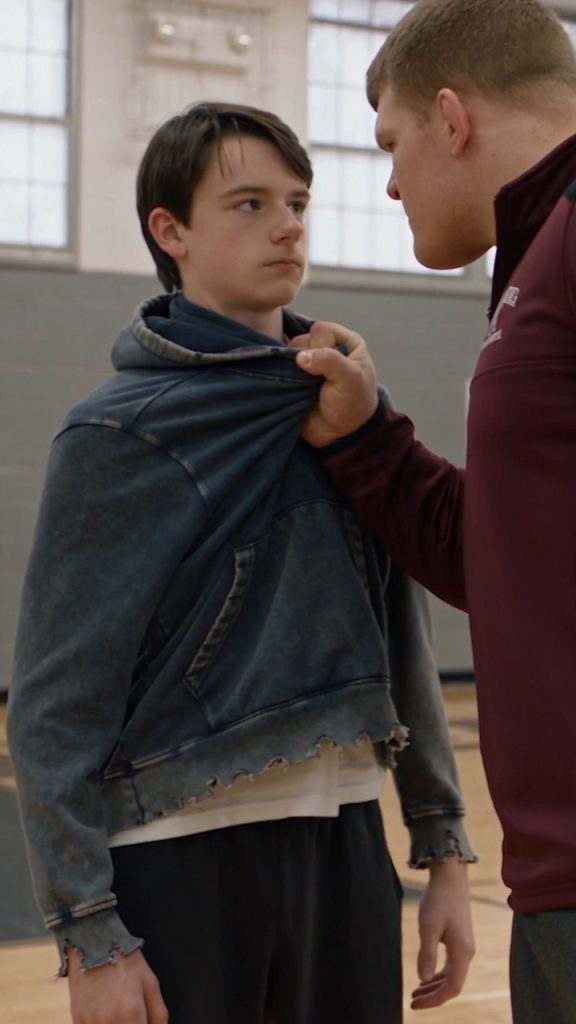
Ruiz asked me to sit in the same conference room as before. This time her notebook was open to a page headed with the date, not with my name. She said the next stage of the review concerned how to distinguish actions the school could establish from motivations it could not.
“Coach Miller has provided a written account,” she said. “I want to explain what it covers, because you’ve asked about his role.”
I felt the old anger rise. “Does he say he saw Brody grab me?”
“No. He says the opposite. He was attending to his phone and did not witness the physical start. He looked up after the noise and the accusation, saw you standing apart and Brody rising from the floor, and heard Marcus report that the doorway group was arranged before the confrontation. He also recalls Brody telling Marcus to be quiet.”
I looked out through the window in the conference-room door. The hallway was empty.
“So he isn’t going to say he saw the whole fight?”
“He hasn’t claimed that.”
It would have been easy for Coach to pretend he had paid closer attention. He could have said he saw something from the corner of his eye. I had spent days angry at his inattention, and the anger hadn’t disappeared. But I was grateful he hadn’t tried to solve his mistake with another lie.
“Is anything going to happen about him being on his phone?” I asked.
“His supervision is being reviewed through a staff process. I’m not going to discuss a personnel decision with you today, but I can tell you your concerns are documented and that the supervision arrangement has already been changed.”
It wasn’t a satisfying answer in the way I had once imagined satisfaction. There was no moment when an adult turned to another adult and said, in front of everybody, that I had been right about everything. There was a record of what the coach admitted he had missed, a change to who watched the gym, and a process I couldn’t observe from the inside.
Ruiz asked if I wanted to amend my statement after reviewing the original clip. I gave her the dated correction about Owen’s phone angle dipping. I also clarified that I couldn’t say whether every JV wrestler understood Brody intended to swing at me. I knew only what Marcus had stated and what I’d seen the boys do.
“Does it bother you to say that?” she asked.
“Yes,” I admitted. “They were there. They blocked the doors. But I don’t want somebody writing that they all knew he’d hit me if nobody can prove it.”
She nodded and added the amendment. The meeting ended with her explaining that Marcus and several others still needed protected follow-up conversations. No student would be required to make an accusation in front of Brody. She didn’t promise me an outcome. I thanked her anyway.
Before leaving her office, I asked Ruiz to show me where I could go if I needed to report a new problem without walking directly through the athletics corridor. It felt embarrassingly practical after so many discussions of evidence. She took a campus map from a drawer and pointed out the counseling-office entrance, the supervised route by the library and the front desk that remained staffed until after activities ended.
“Am I supposed to use that path forever?” I asked.
“No. It’s an option while the review is ongoing. You should have more than one way to feel safe, and we don’t want to make you responsible for avoiding everybody else.”
We looked at the small rectangle labeled GYM. On paper it was only a room between corridors. I marked the main entry with a pencil, and we discussed how an adult would be positioned to see the locker-room doors during the open period. I wasn’t being asked to approve a safety plan as if I were the administrator. But I was able to explain that a room felt different when the only clear exit was occupied by people larger than I was, and that putting a supervisor near the doorway would make a real difference.
Ruiz asked if I wanted to avoid the gym until the decision. I said I might not go in for another day or two, but I wanted the right to choose. She wrote that down, too. When I stepped back into the hallway, I was surprised to find that discussing doors and sightlines had settled me more than rehearsing the argument about Brody. An actual safety plan was made of small, measurable things people could do, not just assurances that adults cared.
I found Coach Miller at the gym entrance later that afternoon, standing near the propped-open doorway as students filed into supervised activities. Another staff member was checking attendance inside. It was the first time I’d seen him close enough to speak with since he’d looked up from his equipment box.
He straightened when he noticed me. “Noah.”
I stopped on the edge of the corridor. The exit was clear behind me. “Coach.”
For a moment I thought he might say he was sorry that things had gotten out of hand, a phrase that would make the event sound like weather. Instead he said, “I should have been watching that gym.”
“Yes,” I said.
He looked toward the open door. “I didn’t see the first part. I wish I had.”
“I wish you’d heard me when I said I didn’t want trouble.”
His mouth tightened. “I understand.”
I wasn’t sure he did. But I could see that he wasn’t asking me to make him feel better. We stood in the corridor with ordinary school noise moving around us. I could have listed every moment when his attention would have mattered. I could have told him how the cheer from the bleachers had sounded like an answer to the question of whether anyone cared. Instead I said, “Please keep looking up.”





