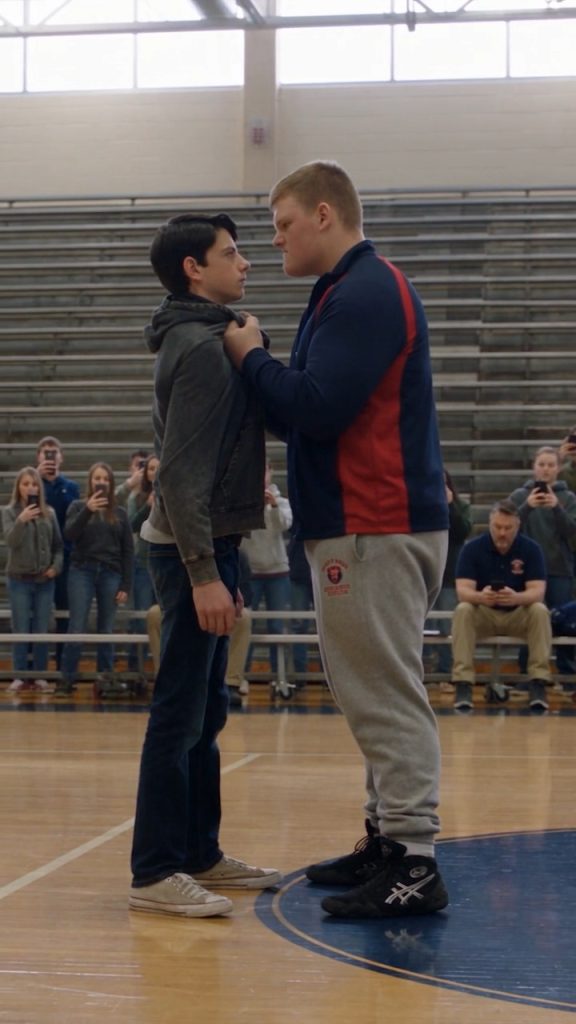
Brody Keller had my hoodie twisted around his fist when I noticed the first phone go up.
It belonged to a girl sitting three rows into the north bleachers. A moment later another screen lifted, then another, until the gym seemed full of little bright rectangles pointed at the two of us. We were near the foot of the bleachers, close enough that the metal risers rang when Brody drove his shoulder into me. He was taller by half a head and built like somebody had drawn a rectangle around his chest. My old charcoal hoodie tightened against my throat.
“On your knees, charity kid,” he said.
A few people laughed, but nobody sounded surprised. The worst part about having a nickname for years was the way strangers could use it as if they had earned the right. Mine had followed me from middle school into Westridge Academy, across bus rides and classrooms and now onto the polished floor of a gym that smelled of cleaner and old sneakers.
Brody tugged me toward the open court, then shoved me back against the bleacher edge. His junior-varsity teammates had arranged themselves across the locker-room doors on the east wall. The main hall exit on the west side wasn’t locked, but it lay beyond Brody and a long strip of open hardwood. Coach Miller sat thirty feet away on a wheeled equipment container near the southwest wall, thumbs moving over a black phone.
Brody leaned close. “You think those test scores put you at our table? You think you can stare at Sarah and get away with it? Apologize. Down there.”
I looked past his shoulder. Sarah Lin sat partway up the bleachers in a plum cardigan, her face tight with a kind of anger I couldn’t yet identify. I hadn’t been staring at her. We’d exchanged two sentences about a chemistry assignment after lunch. Apparently that counted as an offense to Brody, who seemed to believe the gym, the lunch tables and other people’s conversations belonged to him.
“I’m not trying to start anything,” I said.
“Then you’ve picked a terrible afternoon.”
His right arm shifted back. On the floor, his front foot rocked a fraction before settling toward the heel.
I’d learned at seven that fear was easier to carry when I gave my lungs something simple to do. Breathe in. Breathe out. Let the noise remain noise. At eleven I started taking an inexpensive weekly movement class at a community center, where the instructor spent more time teaching us how to fall safely than how to win anything. I never earned a belt or entered a competition. I did learn how obvious a body’s decisions became when you watched its balance instead of its fists.
I let my arms remain loose. “You can let go.”
He pulled harder. The phones stayed pointed at us. Coach Miller didn’t look up.
I brought my feet together, eased the bunch of cloth free of Brody’s grip, and bowed once. Not deeply. Not dramatically. Just enough to mark a pause and give him room to take it.
Confused laughter traveled through the bleachers.
“What is that?” Brody demanded. “You making fun of me?”
I showed him both hands, empty and open. “This is your final opportunity to walk away.”
He stepped toward me, and his front shoe struck the hardwood.
I moved aside before his shoulder reached mine. He caught at the place where my sleeve had been; I guided the reaching arm past me and kept moving instead of holding on. Brody’s own speed carried him several steps toward center court. He caught his balance, turned red around the ears and spun to face me.
There was a thin chance that the interruption would be enough. I took two steps backward, palms still visible. He saw the space, mistook it for an invitation and rushed again.
This time there wasn’t room to let him pass without someone behind me getting hit. I caught his reaching arm, kept close to the movement and turned with him. My practice from the community center felt neither heroic nor elegant. It felt like remembering where the floor was. Brody came down on the hardwood in a controlled, solid landing. He made a startled sound. I released his wrist and elbow at once and retreated until there was six feet between us.
No second hold. No strike. My breath was loud in my own ears, but my hands stayed open.
The gym went nearly quiet, except for a shoe squeaking somewhere high in the bleachers.
Then Brody pushed up to one knee and shouted, “He attacked me!”
Coach Miller finally lifted his head. His gaze landed on Brody rising from the floor, then on me standing apart, then on the phones. He stood so quickly the equipment container squealed against the court.
“Nobody move,” he ordered.
Brody spoke before he was entirely upright. He said I’d fooled him with some weird little performance, grabbed him without warning and thrown him down. The words tumbled together faster than the incident itself had happened. Coach Miller listened with a rigid expression I recognized from the few times teachers caught students talking after the bell: the face of an adult trying to reconstruct events he hadn’t actually seen.
I wanted to tell him everything. Instead, I looked toward the nearest phone, the one with a dark green case held by a girl in a blue plaid overshirt.
“Please keep recording,” I told her.
Her braid lay over one shoulder. She hesitated, then steadied the camera.
Sarah came down from the bleachers, her white shoes striking each step. “Brody, just stop.”
“What?” he snapped toward her, as though she’d interrupted a conversation that belonged to him.
A younger wrestler stepped out from the cluster at the locker-room doors. He held a phone in a black case without looking at it. Brody stared at him, and the boy nearly stepped back into line.
Coach Miller pointed. “Did you see how this started?”





