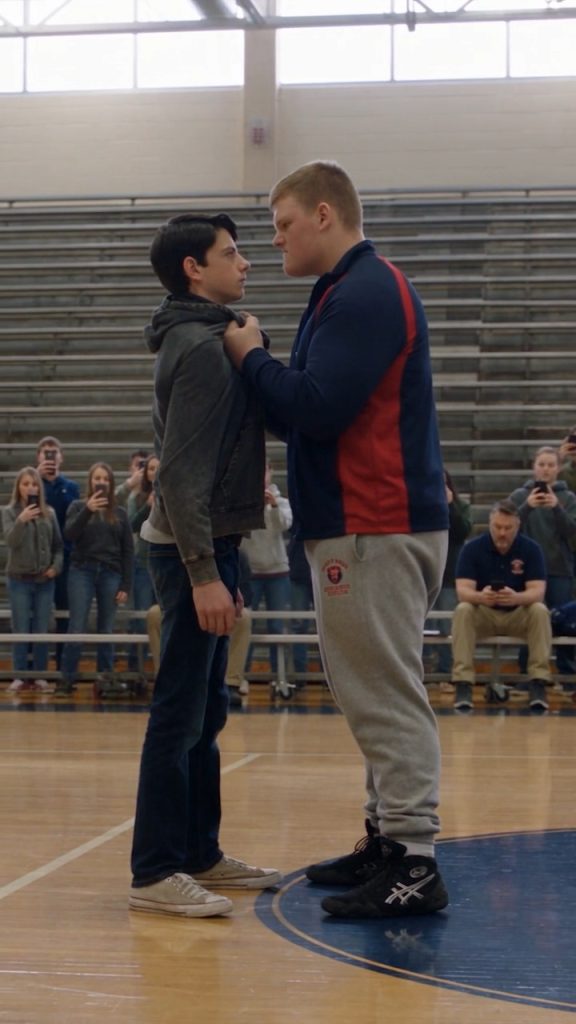
The boy swallowed. For a few seconds, all he seemed able to do was inspect a scuff on the hardwood.
Then he said, “Brody told everyone to stand in front of the doors.”
The words didn’t make anybody cheer. They made the room feel smaller.
Brody gave a sharp laugh. “We were waiting for practice.”
“The team meeting was over,” the younger boy said softly. “You said to stand there so he couldn’t go through.”
I looked toward the doors. I had noticed the line of bodies, the way their shoulders formed a barrier, but I hadn’t heard any instruction. Hearing it out loud turned an ugly impulse into something planned.
Coach Miller rubbed a hand over his mouth. “Everyone away from the doors. Now.”
The boys moved. Nobody argued with that order. The western exit remained empty, and I realized I’d been thinking of it as impossible rather than physically closed. Fear could draw walls where there weren’t any.
“Did you touch him first?” Coach Miller asked me.
“He grabbed my collar and pushed me into the bleachers. He rushed at me twice. I moved away the first time. I stopped him the second time and let go.”
“That’s not what happened,” Brody said.
“Then we need to hear from people who saw it,” I replied.
I surprised myself with how steady my voice sounded. The muscles around my ribs were trembling under my sweatshirt.
Coach Miller took out his phone again, this time lifting it to his ear. He requested Dean Ruiz at the gym. He didn’t announce who was guilty. Perhaps he knew he couldn’t. Perhaps the faces around him had made that clear.
People began to lower their phones. Several were already looking down, tapping rapidly. A boy behind Sarah whispered that someone had posted it. I knew how that worked. By the time a story reached the first classroom group chat, it already had a beginning chosen by somebody else.
The girl in plaid slipped her phone down to chest height, still facing us. She didn’t offer me a reassuring smile. I appreciated that more than I would have appreciated a speech.
When Dean Elena Ruiz arrived from the main hallway, she asked Coach Miller who needed medical help. Brody said his arm hurt. I told her my throat was sore where my collar had pulled. Neither of us showed an obvious serious injury. She had the school nurse check us separately instead of pretending that the absence of blood meant the incident was harmless.
She also asked the crowd to stop sharing footage while the school looked into what had happened. Nobody could put a circulated clip back inside a phone, but her request made a few people lower their screens in embarrassment.
At first she spoke to us in the gym because she needed to know where everyone had been. She asked which doors people had used, who had been near the bleachers, and who had personally seen contact rather than heard shouting. Brody kept trying to answer for other people. Dean Ruiz held up a hand each time.
“One person at a time. And don’t guess about what you didn’t see.”
That instruction made the room strange. Everyone had an opinion, but fewer people seemed ready to describe a fact.
The younger wrestler was led toward the hallway with another staff member for a separate conversation. His shoulders sagged, and I wondered whether he understood what he’d just risked. I didn’t even know his name. Across the floor, Brody had gone quiet; he watched the doorway the boy used, not me.
Dean Ruiz turned to Sarah. “We can speak privately.”
“Yes,” she said. “I’d prefer that.”
I was relieved. I had no desire to make Sarah stand between Brody and a crowd again, or to turn whatever she knew into another spectacle.
The girl with the green phone was the last person near the lower bleachers when Dean Ruiz started moving us out. I recognized her then: Maya Patel, from my eleventh-grade English class. We’d once been partners for a discussion on a short story neither of us particularly liked. I remembered she’d argued that a character could know something was wrong and still be afraid to say so. I hadn’t thought much about it until now.
Maya looked at me as if she wanted to speak, then glanced up at the other students. “Are you okay?” she asked quietly.
“I think so.”
She nodded, but her fingers tightened around her phone. I didn’t ask what she had filmed. It had been close enough to see the crowd and the camera pointed in our direction. It hadn’t been close enough for me to know what she had captured, and I didn’t want to turn one person’s uncertainty into a demand.
In the dean’s office, I sat across from a bowl of wrapped mints that looked absurdly cheerful. A clock made tiny clicks as its second hand moved. Dean Ruiz asked me to describe the incident from the first thing I personally remembered, without arguing with Brody’s version.
I told her about the collar. The shove. The bleachers pressing my back. The doors blocked by younger wrestlers. What Brody had said about a scholarship and Sarah. The bow. The warning. Both charges. Each time I reached a point where my memory blurred with noise, I said so. I couldn’t remember whether two or three people laughed after the bow. I could remember that I had released Brody the moment he reached the floor.
She took notes in a lined notebook instead of finishing my sentences for me.
“Why did you bow?” she asked.
“At my movement class, it’s a way of saying we’re responsible for what we do next. I wanted a pause. I hoped he would leave.”
“Do you think he understood it that way?”
“No.”
“Then we’ll need to separate your intention from what he thought he saw.”





