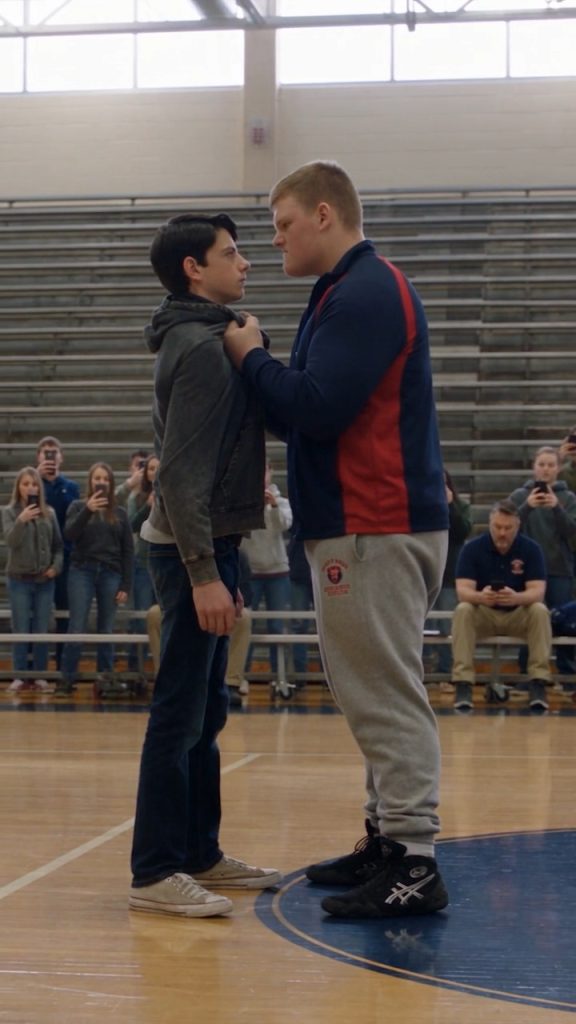
Later that afternoon, Dean Ruiz called me in for a brief follow-up. She didn’t show me Maya’s file or offer to send it. Instead she asked about what was visible from the north bleacher aisle and what I could remember hearing through the crowd.
“Could someone filming from that position see your whole left arm during the initial shove?”
“I don’t know. Brody was between me and the bleachers for part of it.”
“Could a microphone there pick up everything said at the locker-room doors?”
“No. Those were on the other side of the gym. And I didn’t hear what Brody told them before he grabbed me.”
“Good,” she said, not because the gaps were good, but because I hadn’t tried to fill them. “The file helps us understand several moments. We still have to ask people who were in different places.”
She mentioned that two other students had voluntarily submitted recordings that began at different times. I remembered the raised phones and the sudden angle of the room. Those cameras had been instruments of humiliation while Brody held my collar. It was strange to learn they might also help limit the damage of his accusation. Not one of them had been raised for my sake.
After school, I went to my community center class for the first time since the incident. The room was above a small municipal gym, with a blue mat that smelled faintly of disinfectant. My instructor, Mr. Hale, was an ordinary man in his sixties who checked that everyone could move safely before asking us to practice anything. He noticed the way I kept looking toward the door.
“You want to sit out today?” he asked quietly.
“I want to be here. I’m just tired.”
“Then be tired here. You don’t have to demonstrate anything.”
I spent most of the session helping younger students lay out mats and practicing the sort of easy balance shifts we’d done a hundred times. Nobody asked whether I could beat a varsity wrestler. Nobody called what I’d done in the gym impressive. When a child fell while stepping backward, Mr. Hale helped him stand and asked how it felt. The answer, “A little scary,” was accepted without argument.
Before everyone left, I stayed to help roll up the edge mats. Mr. Hale waited until the younger students had gone down the stairs before asking whether something had happened at school. He didn’t know about the clip; at least he gave no sign of knowing. He had noticed how often I checked the door and how carefully I avoided being touched while moving the equipment.
“There was an incident,” I said. “I tried to stop somebody from hurting me. The school is reviewing it.”
“Do you need help explaining what we practice here?”
“Maybe. But I don’t want someone saying you trained me to fight a wrestler.”
He nodded. “Then describe it accurately. We work on awareness, balance and getting away safely. You’ve never been here to prepare for a school confrontation. That doesn’t mean you’re obligated to stand still if someone rushes you.”
I didn’t ask him to call the school, and he didn’t volunteer a letter with impressive language about my skills. His answer made the class feel like mine again, instead of a secret that could be used against me. As we put away the last mat, he reminded me that practice was supposed to give me choices under stress, not turn every stressful moment into a competition.
Outside, mist collected along the community center steps. I stood there under the roof until Mom’s car pulled up. I realized I’d gone nearly an hour without thinking about how Brody had looked on the floor. That was worth noticing. Some part of my life had remained outside the gym.
On the ride home I told Mom that I hadn’t used the class to prepare for a fight. She said she knew. I asked whether staying quiet for years had been a mistake.
“I don’t think quiet is a mistake,” she said. “I think people sometimes mistake it for permission. Those aren’t the same thing.”
Friday brought more concrete changes, though not the kind people in the group chat were predicting. Dean Ruiz invited my mother and me to a scheduled meeting with Nina Brooks, Westridge’s athletic director. Mom had arranged another shift adjustment and arrived with a notebook in her bag. Ms. Brooks was tall, with close-cropped hair and a gray quarter-zip that carried the school crest. She took the seat across from us, not at the head of the conference table.
“My responsibility covers team participation and captaincy,” she explained. “Dean Ruiz handles the broader conduct review. We are sharing information because the event involved a team captain and students wearing team practice clothes.”
“Does that mean an athlete’s word is more important?” Mom asked.
“No,” Ms. Brooks said. “It means I have to examine whether team responsibilities were misused, separately from whether a student broke general school rules.”
I appreciated that distinction, though it frightened me too. Brody had spent years in a system where people knew his name because of what he could do on a mat. I was sitting before the person responsible for that system, asking her to consider what happened when he carried his authority outside a match.
“Are the JV boys in trouble?” I asked.
“We are reviewing individual conduct, not assigning a single punishment to everyone who stood near a door,” she said. “We need to distinguish who followed an instruction, who understood what it was for and what each person actually did.”
“The younger one told the truth,” I said.
“We’re aware a student began describing an instruction in the gym. His decision to speak is relevant, and he still deserves a private, fair review of his own actions.”
I nodded. That was more complicated than treating him as either a hero or a villain, but it was closer to what I’d seen: a boy who had stood in the line and then stepped out of it.





