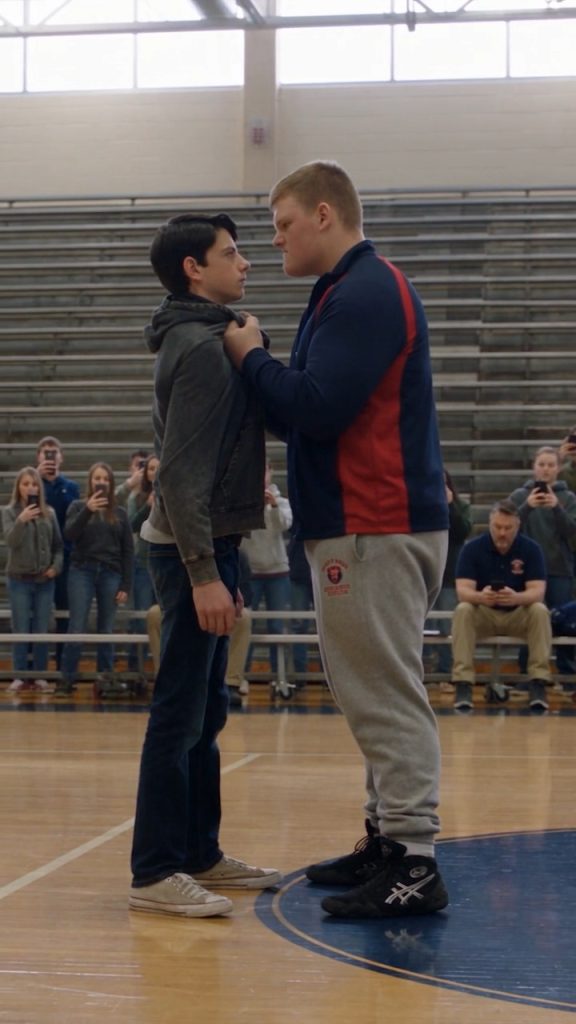
I reported the situation to Dean Ruiz not as a claim of retaliation but as a concern: Noah had been standing with teammates, seemed upset and had already told me he was worried about being known as the person who spoke. She listened, then asked whether I’d heard any threat.
“No.”
“Did anyone approach you?”
“No.”
“Then we’ll check on student safety without making an allegation you can’t support.”
She thanked me for keeping those distinctions. I was starting to recognize that a fair process wasn’t built from dramatic accusations, even when those accusations might have felt satisfying.
On Tuesday evening I tried to read the witness grid again. I had stopped adding new information, but I kept making the columns neater, as if a straighter line between statements would produce a decision. Mom sat on the other side of the table sorting the week’s bills. She watched me erase a heading for the third time.
“Is the page telling you something new?” she asked.
“No.”
“Then it’s allowed to be finished.”
I put the pencil down. “What if I left out a detail?”
“You told the truth as carefully as you could. If you remember a real detail, you can add it. But rewriting the same page won’t make other people agree with you faster.”
I looked at her envelopes. Some were stamped with due dates. The scholarship mattered here, in this room with its narrow kitchen counter, in a way no one calling me charity kid seemed to understand. Mom had always been clear that the award recognized my academic work. Yet I knew the difference between being told I belonged and feeling secure enough to believe it. She pushed the notebook gently toward me.
“Come help me make dinner,” she said. “School can have your statement tomorrow. It doesn’t get every minute of tonight.”
On Wednesday morning my mother joined me for another meeting. She wore the same practical blouse she’d worn the first day, freshly pressed, and her hair was pinned into a tighter bun than usual. On the way over she had told me that if I wanted her to do most of the speaking, she would. I said I wanted to try answering for myself, and she agreed to step in only when I asked or when a decision about my safety needed an adult voice.
Dean Ruiz explained that interviews had been conducted separately and that the school was checking accounts against the recordings’ timing and sightlines. Athletic director Brooks had been involved where team responsibilities and supervision overlapped. No result had been reached. None of the students was being asked to confront another face-to-face as part of the review.
“Have you spoken with Coach Miller?” Mom asked.
“Yes. He confirmed he was looking at his phone during the beginning of the incident and did not witness the initial grab or the first rush. He became aware of the physical confrontation after Brody was down. His supervisory conduct is a separate staff issue.”
I didn’t ask what had been on his screen. The contents of a phone weren’t what mattered to me. The simple truth was that a responsible adult had been thirty feet away and had not looked up when a student was pushed into the bleachers.
“What about Brody?” I asked.
“He has given his version and has an opportunity to respond to the information we’re reviewing,” Dean Ruiz said. “I can’t disclose the details of a student’s confidential meeting to you. I can tell you that there are disagreements about the meaning of your bow, the extent of the physical contact and whether your response was defensive.”
Mom leaned forward. “But are they considering the two charges separately? Because one clip I saw started after the first one.”
“Yes. We are distinguishing the sequence. We aren’t relying on the widely shared edit as a complete account.”
My mother sat back. I could see her make a small mark in her notebook. She had spent the week turning fear into questions that could be answered. The page was lined with tiny boxes, several now checked.
Then Dean Ruiz brought up the possibility of a brief communication to families or students if the rumors continued. She said some people had suggested a neutral statement that both boys had been involved in a physical incident and that the school had addressed it. She didn’t present it as a final finding, but as a possible way to calm attention without exposing private details.
“Would that satisfy your concern about the rumors?” she asked.
For one second it was tempting. Both boys involved was the kind of sentence an institution could issue without making anyone too angry. It would leave room for Brody to claim the school blamed us equally. It would also stop the questions, at least from people who wanted an easy ending.
“No,” I said.
The word came out louder than I’d intended. Mom turned toward me, but she didn’t interrupt.
“I was involved because he grabbed me,” I continued. “If the school says we were both in a physical incident, that’s technically true. But that’s what the cropped clip already says. It leaves out why I moved and why I stopped. I’m not asking you to tell everyone his punishment or show them the videos. I’m asking you not to make the correction another missing beginning.”
Dean Ruiz folded her hands. “What would you consider accurate?”
“You could say the school has reviewed the full sequence, and that the short repost shouldn’t be treated as a complete account. If you reach a finding, you can say whether I was found responsible without saying everything about him.”
Mom looked at me with an expression I couldn’t read. Dean Ruiz made a note.
“That’s a thoughtful distinction,” she said. “We’ll consider the scope of any communication after a decision is made.”
It wasn’t a victory. She hadn’t promised to use my words. But I had refused a version of peace that depended on accepting equal blame for something I hadn’t started.





