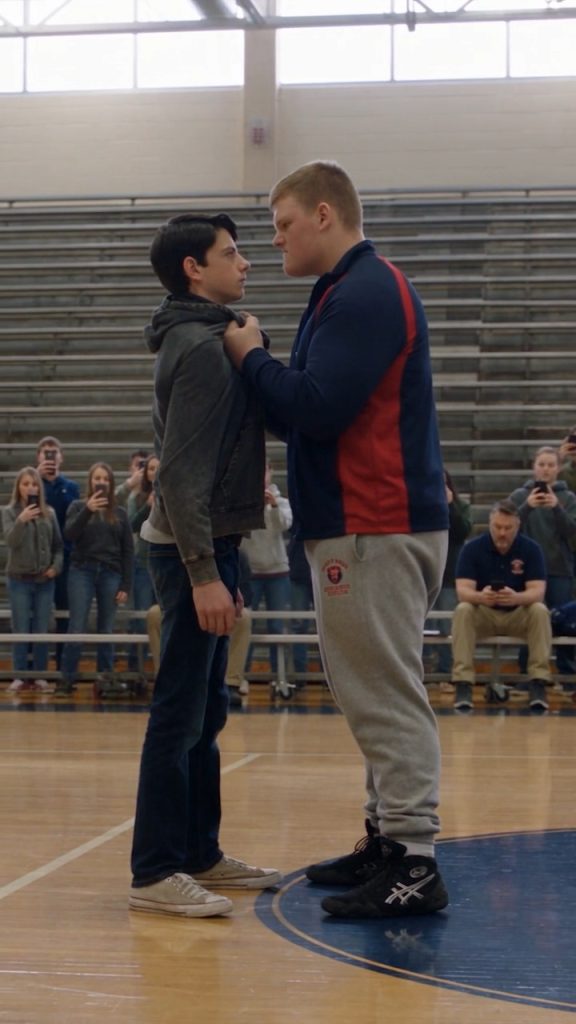
I thought of the way I’d backed away after both charges. The decisions that had felt automatic now seemed to require paragraphs of explanation. I wished Coach Miller had noticed in time to stop the first shove. A few words from an adult could have prevented everyone from needing to discuss my wrists and Brody’s feet in this much detail.
I told her that too, carefully. She didn’t defend the coach or offer excuses about how busy schools could be. She said, “The supervision failure is being examined separately. You aren’t responsible for making an adult pay attention.” I wrote the sentence down later, because it was the first time somebody from Westridge had put that part of the responsibility where it belonged.
We walked through the first rush in small pieces. Where had my feet been? Where had Brody ended up? Had I held his wrist after he stumbled? I explained that I had guided his reaching arm past me and released it, then backed away. We walked through the second charge. This time he had come toward me faster, and a person was still near the bleacher area behind my right shoulder. I had caught the arm reaching for me, kept the movement close and turned until he was on the floor. I told her I couldn’t measure the force in any scientific way. I only knew I hadn’t wanted to injure him and had stopped the instant he was down.
Dean Ruiz asked something I hadn’t considered. “Did you think about moving away after the first rush?”
“I did. I took steps backward.”
“Did you think about running?”
“Yes. But he turned and came straight back. I didn’t think I could outrun that from where I was standing.”
She nodded without praising the answer. That made me feel safer than being congratulated. She wasn’t searching for the strongest possible version of me; she was trying to understand the one who had been there.
Finally she asked about the bow.
“I brought my feet together and lowered my head. Once,” I said. “At the community center, we begin and end practice with a bow. It’s a reminder that how we behave matters. I wanted Brody to know I wasn’t going to play the humiliation game.”
“Could another student have interpreted it as a challenge?”
“Yes,” I admitted. “People laughed. Brody asked if I was making fun of him.”
“What did you say then?”
“I raised my hands and told him it was his last opportunity to walk away.”
“Why choose those words?”
I had replayed that sentence so often that I nearly answered with a rehearsed defense. Instead I remembered the actual feeling: the cold bleachers against my back, the phones, the certainty that his arm would move.
“I thought if I sounded firm, he’d understand I wasn’t going to kneel. I was scared. I wanted him to stop.”
She placed her pen down. “Both things can be true: you meant to deter him, and he may have interpreted your words differently. The question of who initiated physical aggression still needs to be answered from the full sequence.”
When I left the office, a school counselor walked with me through the west corridor. I’d been offered the escort again, but this time I’d said I only needed it near the gym transition. She respected that. We passed an open doorway where students were stacking folding chairs for an event. Nothing about the scene was threatening. I still felt a jolt when a chair scraped sharply across the floor.
The next day, Tuesday, Maya asked if we could sit at the far end of a cafeteria table. She had kept her distance since sharing the original. I didn’t blame her. People had begun making jokes about which students were “on Eli’s side,” and the joke had a cruel edge whenever the speaker belonged to the wrestling circle.
“Dean Ruiz asked me to explain where I held the camera,” Maya said. “Again.”
“Did she think you’d moved?”
“She wanted to know if the view went behind Brody’s shoulder when he was shoving you. I said it did for a second, because I was at the aisle and he was between us.”
I stirred my soup even though it was already mixed. “Does that make the video less useful?”
“It makes that second less visible. It doesn’t make the rest of it disappear.” She pushed a stray hair from her face. “I also told her I could hear your warning but not every word Brody said at first. The crowd was yelling. I don’t want somebody watching it later and deciding I heard more than I did.”
“That’s the right thing to say.”
“I wish the right thing didn’t make me nervous.”
I looked at her green phone case beside the tray. It had a scratch at one corner. Ordinary objects were becoming symbols in my head: the case meant an original recording, the navy jacket meant Brody, the maroon practice shirt meant the young wrestler who had spoken. Maya caught me looking.
“I’m still not putting it online,” she said.
“I don’t want you to.”
She studied me. “You really don’t?”
“People already made a spectacle out of me. I don’t need the correct version to become another spectacle. I just need the adults deciding what happened to have it.”
“Good.” She drew the phone back toward herself. “Because it’s mine, and I’m keeping it.”
Later that day, I saw Noah at the end of a corridor with two teammates. One said something I couldn’t hear. Noah’s face went still. When he noticed me, he didn’t acknowledge me. I kept walking. I couldn’t know if the conversation had been about me, his statement or something as ordinary as homework. The fact that I wanted to know was proof of how much uncertainty had taken over.





