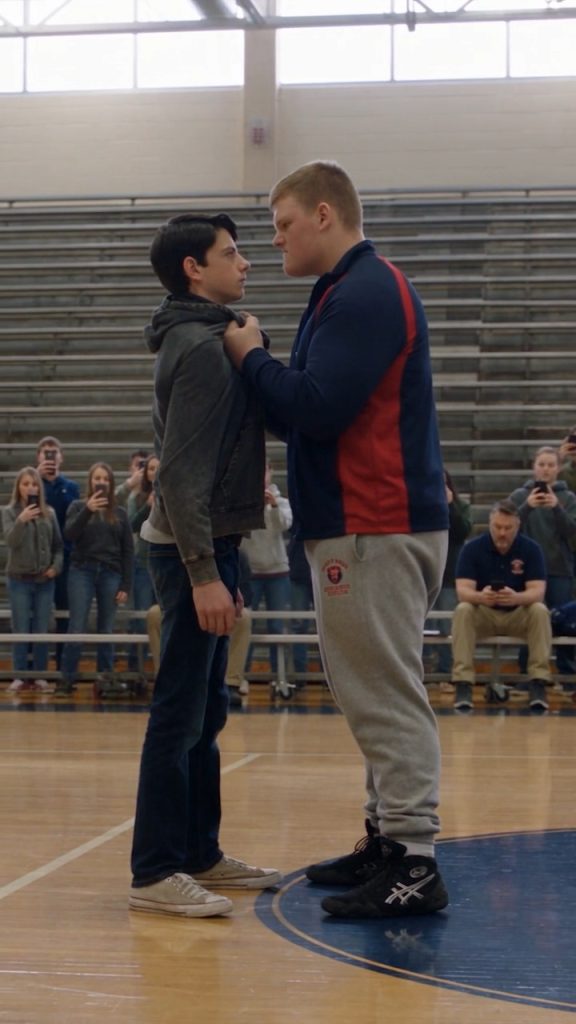
The word intention made me nervous. I had chosen to bow. I had chosen to speak with a confidence I hadn’t felt. If my choice had made him angrier, someone might decide I had invited him to attack. I had spent years being told that quiet children were safe children. It turned out quiet wasn’t a guarantee of anything.
Dean Ruiz asked whether I felt safe going home. I said yes, because my mother’s car would be at the employee pickup lane after her shift. I did not tell her how I kept picturing Brody waiting at the west exit. She noticed my glance toward the office door anyway.
“We’ll have a staff member walk you to pickup today,” she said. “That’s a temporary precaution, not a judgment.”
I thanked her. She asked that I write down anything else I remembered that evening and bring it the next day. She didn’t ask me to surrender a phone I didn’t have or to find out who had posted what. She told me not to contact Brody about the incident.
My mother arrived in her black work trousers and striped blouse, still wearing the name tag from her shift beneath her coat. I could see her read my face before I found words. The staff member explained that a confrontation had happened and that the school was investigating. Mom took one look at my stretched collar and put a hand lightly on my shoulder.
“Are you hurt?”
“Mostly shaken.”
She nodded as though that deserved to count.
We drove past bare patches in the trees bordering the academy drive. October light turned the windshields in the pickup line into pale squares. Mom didn’t interrogate me at the first stoplight. She waited until we’d entered the slower streets near our apartment, where the bakery on the corner had already flipped its sign to CLOSED.
“Start wherever you can,” she said.
I started with Brody’s hand. Once the first sentence came out, the rest wasn’t as difficult. I even told her about the bow. I expected her to ask why I hadn’t just walked away. Instead she asked whether the west door had been clear and whether I could have reached it without passing him. I told her the truth: maybe, eventually, but not in the few seconds when his fist was in my sweatshirt and the team occupied the other doorway.
I remembered the day my acceptance letter arrived, the spring before ninth grade. The envelope had been heavier than an ordinary school letter, with a second page explaining the academic merit award. Mom had read the amount once, then turned the page over as though checking for a catch. My test scores had mattered, but she never let me forget the hours behind them: library tables after her late shifts, free practice books, scratch paper crowded with calculations. Westridge was a school we couldn’t have paid for without that award. That fact made Brody’s insult sting in a way his size didn’t.
At orientation I had expected the other students to be smarter than me, which was frightening but manageable. I hadn’t expected the way some classmates discussed tuition and vacations like weather. When a boy in middle school learned I got help paying for school, he called me a charity case. By ninth grade, the name had shortened to charity kid, as if being admitted on merit were something to apologize for. I’d learned to laugh weakly or look down until people got bored. Occasionally they did. Sometimes they merely waited for another day.
There were teachers who treated me like everyone else, and students who asked for my notes without commenting on where I lived. Westridge wasn’t one enormous hostile crowd. That was part of why the gym hurt so much. It took ordinary faces, people I’d lent pencils to and shared lab tables with, and turned them into an audience for somebody demanding I kneel. I didn’t want to leave the school. I wanted the school I’d worked so hard to enter to be a place where I could stand upright.
At home she heated rice and beans from the previous night while I sat at our small kitchen table. When I was younger, she used to tell me that winning a scholarship meant I had been given a chance, not an obligation to accept mistreatment. I had believed her in the abstract. It felt different now with tuition figures and disciplinary records suddenly tangled in my mind.
“You won’t lose your place because somebody else grabbed you,” she said.
“I don’t know that for sure.”
“Neither do I. That’s why we’re going to find out what the school actually says, instead of deciding based on what Brody wants us to fear.”
She laid a legal pad beside my plate. “Write the sequence while it’s fresh. Your words. I’ll sit here.”
I wrote the time as approximately 3:25. I listed the east doors and west exit. I described Coach Miller sitting on the equipment container, but I didn’t write what he was doing on his phone because I couldn’t see the screen. I wrote Sarah’s exact words and the younger teammate’s first sentence. There was something calming about leaving space for what I didn’t know.
My phone buzzed after dinner. A class group chat had sent a video. The preview showed a broad shoulder in a varsity jacket and my hands on Brody’s arm. I opened it even though I knew I shouldn’t.
The clip began near the second charge. The first grab, the shove, the bow, the warning and the first rush were gone. In three short seconds I looked like the person who had decided to throw the wrestling captain onto the gym floor. A text above it read: ELI LOST IT.
More messages arrived beneath. Some people called it impressive. Others called it a cheap shot. A few wanted another fight, as though the afternoon had been a match they could schedule again.





