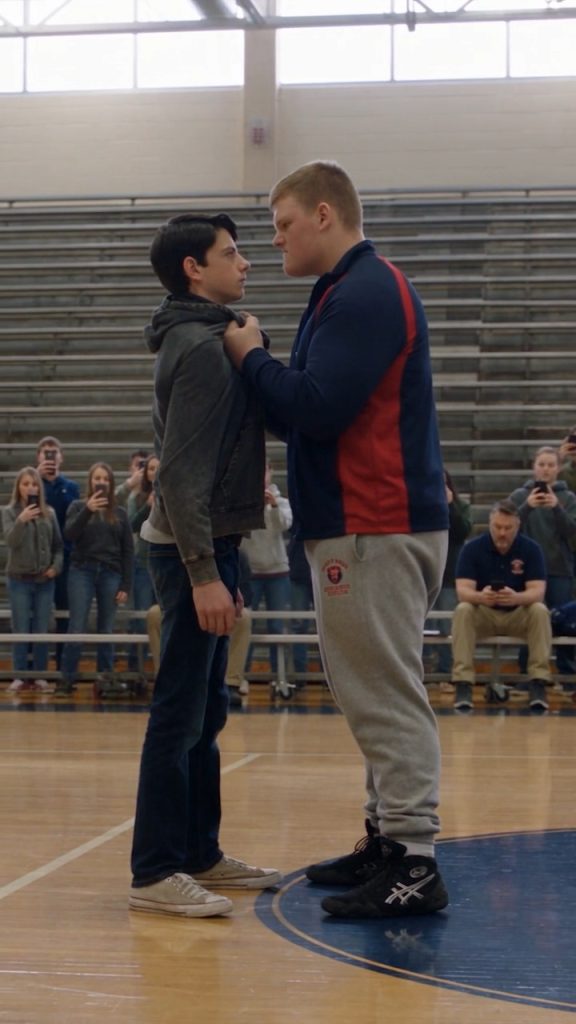
Dean Ruiz went over the practical plan. Brody and I would have a no-contact direction enforced by the school. A staff member would monitor busy after-school transitions by the gym for the immediate future, especially while team activities continued. I could use the west corridor without being expected to navigate a crowd of wrestlers alone. I had a named contact for reporting intimidation, rumors that crossed into harassment, or pressure on witnesses. The school would review the arrangement with us rather than leaving it in place or ending it without discussion.
“Do I have to avoid the gym forever?” I asked.
“No. The goal is to restore your ordinary access to school spaces safely. You shouldn’t have to give up a class or a route because another student chose to intimidate you.”
It was the answer I had wanted since the moment the JV boys formed a line in front of the locker-room doors.
Mom asked about Coach Miller. Dean Ruiz closed her pen before answering.
“His initial inattention was a serious failure of supervision,” she said. “He acknowledged that he did not see the beginning and that he was focused on his phone during a period he was assigned to supervise. He has received a written reprimand. He will not supervise after-school gym dismissal alone while he completes additional training and review.”
“Is he still coaching?” I asked.
“Yes. These are the measures the school has determined at this stage. We won’t discuss his personnel file beyond the steps affecting student safety.”
I thought about the man on the equipment container, thirty feet away. I had imagined him as a villain while Brody was gripping my collar, then as a failed rescuer, then as an embarrassed adult who at least admitted what he had missed. None of those images was complete. He had failed to do his duty. The reprimand and restrictions were not a time machine, but they acknowledged the failure in a way an apology alone could not.
We talked about the group chat next. Dean Ruiz explained that Westridge would send a narrow message to the affected school community, making clear that a circulating edited clip did not show the full sequence and that the school had completed a review of the encounter. The communication would correct the false impression that I had been found responsible for an unprovoked attack without publishing the videos, identifying cooperative witnesses or listing confidential student sanctions.
“We won’t be able to retract every message someone has already sent,” she said. “But we can stop the school from allowing a false conclusion to stand as if it were its own.”
I looked at Mom. She gave a slight nod.
“That’s what I asked for,” I said. “Not everybody’s phone. Just the full beginning being recognized.”
At the end of the meeting, Dean Ruiz handed us the written finding that concerned me and the schedule for a safety check-in the following week. I read the first paragraph twice, looking for a hidden phrase that would turn it all around. There wasn’t one. My name was spelled correctly. The sequence was described in the order I’d experienced it. There was no suggestion that the bow made the attacks my fault.
Outside, Mom put her arm around me. I leaned into her long enough to feel the tremor in my chest subside. Then she let me go, because I was sixteen and standing in the middle of a school courtyard where classmates could see us, and she understood the difference between care and making a performance of care.
“Are you relieved?” she asked.
“Yes,” I said. After a moment I added, “And angry.”
“Those can both fit.”
I wanted to say the school should have noticed sooner, that someone in the bleachers should have called for help instead of filming, that I shouldn’t have needed an evidence ledger to prove I had wanted to leave the gym. I didn’t say it all. I didn’t have to. Mom knew enough to wait beside me while I found my footing again.
By Friday morning, the school message had gone out. It was brief and deliberately unspectacular. Some students seemed disappointed by the lack of details. Others read it carefully. In algebra, the boy who had called my takedown “moves” offered an awkward nod. A girl who had shared the cropped clip admitted she hadn’t known the recording started late. She didn’t ask me to absolve her. I didn’t make her.
At dinner that evening, Mom made the corn tortillas she usually saved for weekends and set a bowl of warm beans between us. There was no cake, no dramatic toast, nothing that would look like a celebration in a photograph. She simply served me a second helping without asking about the gym. We talked about the academic event I wanted to attend in November and whether I’d need to borrow a blazer. It was the first meal in days that lasted longer than our discussion of the investigation.
Afterward I opened my laptop to check the weekend assignment calendar. The scholarship tab was beside the school portal. I clicked it and saw the same award information that had been there before Brody grabbed my sweatshirt. The number hadn’t changed. Neither had the requirements about grades. I was relieved, but I also felt a little foolish for expecting the screen to be different simply because somebody had called me a name.
Mom came by with a dish towel over one shoulder. “You don’t have to prove you belong every single day,” she said when she saw the screen.
“I know. I just wanted to see it.”
“That’s okay too.”
I closed the tab and opened my chemistry notes. I wasn’t done worrying. I was able to do something else while the worry existed, and that felt like the beginning of freedom.





