After the meeting, Mom and I sat for a few minutes on a bench outside the administrative building. October had turned the air sharp enough that she zipped her jacket to the neck. A maintenance worker pushed a cart of supplies across the courtyard. Students went past in noisy pairs, talking about tests, weekend plans and a basketball scrimmage.
“You did well in there,” Mom said.
“I don’t know whether it mattered.”
“It mattered that you said what you meant. Their decision is still theirs.”
I watched a yellow leaf skid over the walkway. “I’m scared they’ll say I should have just let him hit me.”
“Did you want to hurt him?”
“No.”
“Did you keep hurting him once he was down?”
“No.”
“Then don’t change your account to sound tougher or weaker. Let it be exactly what happened.”
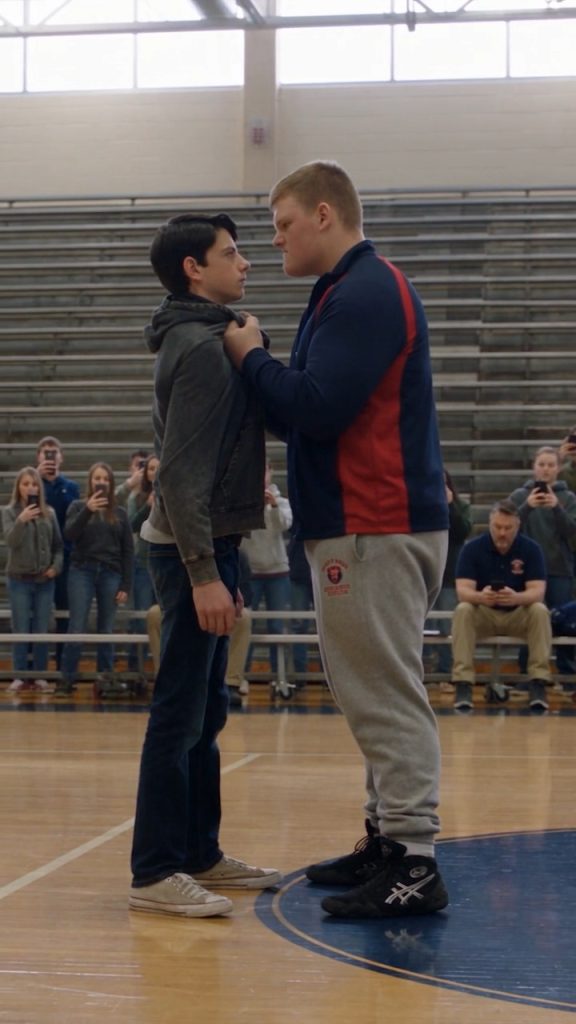
I had expected the worst part of this week to be remembering the shove. Instead it was waiting while strangers decided what my movements meant. Brody’s version of me was an aggressor disguising himself as a quiet kid. The group chat’s version was a fighter hiding behind a scholarship. My own version was a person who wanted to reach the hall without being made to kneel. I didn’t know which would end up in a school record.
On the final afternoon of interviews, Dean Ruiz called me in one last time to check the chronology. She asked whether I wanted to add anything about injuries. I told her my throat had been sore that first evening but was fine now; I hadn’t needed follow-up medical care. I said I had seen Brody stand and argue after the fall and had no knowledge of an injury beyond what he himself claimed. She accepted that limitation.
She asked whether I wanted any additional safety support while the decision was pending. I said I wanted the west hallway escort to continue at dismissal for now, and I wanted the adult watching the gym doors to be someone other than Coach Miller until the process was finished. She said those were reasonable requests and noted them.
Before I left, I asked whether Noah had changed his statement. Dean Ruiz didn’t tell me what he’d said in his private follow-up. She confirmed only that the school had offered witnesses a safe way to provide and verify their own accounts without speaking in front of the students involved. That was all I was entitled to know. I remembered the way Brody had stared at him in the gym and hoped the arrangement had been enough.
I walked back through the science corridor while students were changing classes. A poster for the school’s fall academic showcase had slipped halfway off the notice board; someone had taped it back with a strip of bright blue tape. The ordinary work of maintaining a school continued while the review of its failure moved behind office doors. I wondered whether the staff member who had been assigned to the gym transition knew why her presence mattered so much to me. Probably she knew the broad reason and not the details. That was enough.
A student I hardly knew held a door open for me. I thanked him and passed through. He didn’t ask about the video. His kindness was so small that it should have been invisible, and yet I noticed it. I’d spent days anticipating every encounter as if it could become another confrontation. I was beginning to see that most people had not joined Brody, even if too many had watched him. I didn’t have to turn them all into enemies to describe the harm truthfully.
By the time I reached English, I had settled on one thing I would do regardless of the finding: I would keep using the parts of school I cared about. I’d attend my classes, help at the academic showcase and go to the library. Avoiding danger was sensible; surrendering every familiar place to the memory of Brody would give the incident a longer life than it deserved.
That evening the cropped clip appeared again in a new group chat. I didn’t watch. I saved the message for the school only because the caption used my name and repeated the accusation. Then I closed the app and helped Mom wash dishes. Hot water ran over my hands, and for several minutes the biggest thing I had to decide was where to put a chipped bowl.
The school had the recordings and the witnesses. It had listened to my full account, including the bow that might be used against me. I had refused the easy statement that would make both boys equally responsible in public. I had also given up the fantasy that perfect proof guaranteed a perfect decision.
Thursday, October 29, was the date Dean Ruiz had set for notifying us of the result. I put my legal pad back into my bag that night, though there was nothing new to write. The last page held my own question in the margin: Does the truth still matter when someone powerful doesn’t like how it sounds?
I closed the notebook. I had done what I could. For the first time in my life, doing what I could meant letting someone else decide what happened next.
Dean Ruiz called my mother at nine on Thursday morning and asked us to meet after lunch.
That was all she said. No hint in her voice, no reassuring phrase, no warning. I sat through two classes with the call lodged beneath my ribs. I could still solve a chemistry problem, but I checked every answer three times. In English I turned a page and realized I’d read the same paragraph twice without knowing what happened in it.
Mom met me outside the administrative building shortly before one. She had brought her notebook, though she held it closed against her coat. The sun was bright and the air cold enough that we could see a trace of breath when we spoke. I noticed a student laughing across the courtyard and wondered whether he knew something I didn’t. Of course he didn’t. I had begun to look for answers in every unrelated expression.





