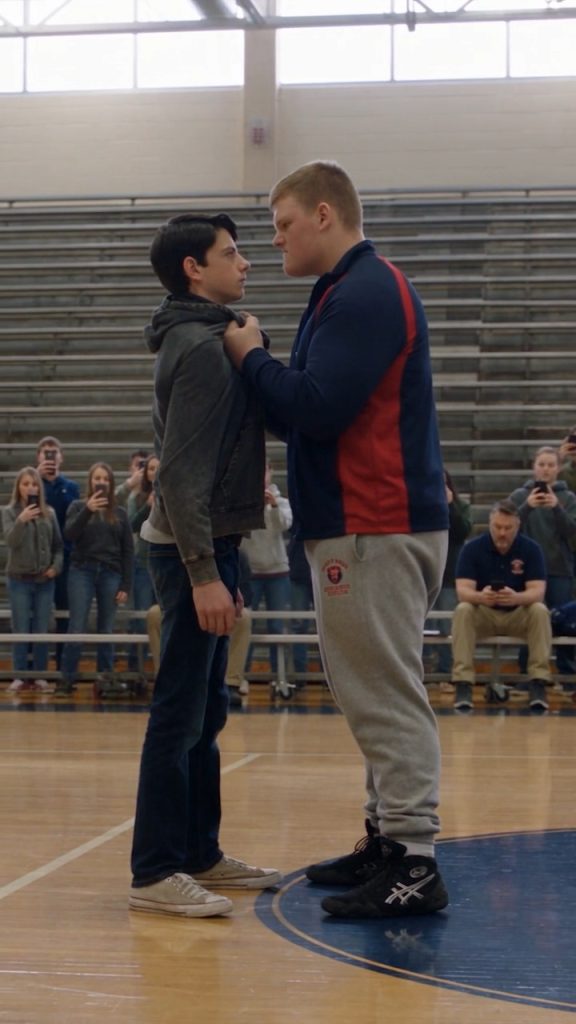
The messages didn’t stop completely. One student claimed the school had favored a scholarship kid. Another said athletes were being unfairly targeted. I had a sudden urge to reply with every line of the finding and a map of the gym. Instead I used the reporting route Dean Ruiz had given me when a message included my name alongside a threat to “settle it.” I did not argue in the chat. The school followed up through its process, and I kept attending class.
Sarah stopped beside me after chemistry. “I heard the school finished,” she said.
“Yes.”
“Are you okay?”
“More okay than I was.”
“Good.” She adjusted her folder. “People still keep asking whether this was about me. I’ve been telling them no. If they don’t believe me, that’s their problem.”
“It shouldn’t have been your problem in the first place.”
She smiled, small and genuine, then left to meet a friend. Nothing about her kindness promised a romance. I was grateful for the simple fact that she could move past me without becoming part of somebody else’s explanation of what happened.
Maya and I met in English later that day. She put her dark-green-cased phone on the desk face down. I told her the school had found I hadn’t initiated the fight, without sharing the confidential parts of Brody’s discipline. She nodded as if she’d been bracing for that sentence all week.
“I’m glad they looked at it properly,” she said.
“They told me it wasn’t just your recording.”
“Good. It shouldn’t have been all on me.”
“I know.”
She ran a finger along the scratch in her case. “I’m keeping the file where it is. Not posting it.”
“That’s your decision.”
She opened her English book. After a moment she said, “I think I want to spend the weekend without a single person asking me about the gym.”
“Same.”
It wasn’t the kind of friendship movie scenes were built around. It was a small agreement between two tired people who wanted their lives back. It felt real.
I didn’t see Brody again that week. The school made arrangements that kept us apart while he served his suspension. His name remained a topic around the hall, but it no longer arrived as a command everyone had to obey. I heard classmates arguing about whether he’d earned his punishment. I didn’t listen long enough to collect their votes. He was responsible for what he had done; my life didn’t need to become a permanent referendum on his character.
The following Monday, I passed Noah near the library. He was carrying a practice bag in one hand and a history textbook under his arm. When he saw me, he slowed, but he didn’t look at the floor.
“They said I’m still on the team,” he told me. “I have to meet with the athletic office about what I did at the doors. I’m okay with that.”
“I’m glad you can keep wrestling.”
“Some guys think I should’ve kept my mouth shut.”
“I don’t think that.”
He exhaled. “I know.”
He looked toward a group of students approaching from the stairwell. I could see him deciding whether to continue talking. I didn’t make the decision for him.
“I shouldn’t have stood there,” he said at last. “I knew he was trying to make you feel trapped. I just didn’t think it would get that far.”
“Neither did I.”
“I don’t want to do that again.”
“Then don’t.”
There was no perfect speech to offer him. He wasn’t innocent of everything, and he wasn’t the person who had organized the confrontation. He had made a frightened choice, then a braver one. Both belonged to him. We said goodbye and went to different classes.
At home, my mother left the written school finding in a plain folder beside my scholarship paperwork. I saw it whenever I opened the drawer to get pens or index cards. At first I read it almost every night, reassuring myself that the sentences hadn’t changed. Gradually I stopped taking it out. I was beginning to trust that a record could remain true even when I wasn’t staring at it.
There were other changes that nobody would have noticed from the outside. I slept through the night twice in a row. I finished a homework assignment before midnight. At community center class, I spent an evening helping children practice stepping backward without losing balance. When one asked whether I’d ever had to use what we’d learned, I said, “Once. I hope I don’t have to again.” Mr. Hale heard and didn’t ask for the story.
On Friday, November 6, I had a reason to cross the gym after school. A notice for an upcoming student academic event had been moved to the board near the west corridor, and I needed to check a time. By then the supervised transition plan was working smoothly. A staff member stood where students could see her near the gym entrance. Nobody made a big show of walking beside me.
The north bleachers were folded partway back. The hardwood was as bright as it had been on October 20. Light from the high windows lay in pale rectangles across the court. I could still remember exactly where Brody had stood, where his heel had shifted, where I had lowered my head and where he’d landed after the second rush. The place hadn’t changed. I had.
The locker-room doors on the east side were open. A few students passed through carrying equipment, speaking to each other in ordinary voices. No wall of JV shoulders. No phones lifted to frame my humiliation. No demand that I kneel before someone would let me pass.
I walked toward the notice board, read the event time and wrote it down. Then I looked across the gym once, not because I needed to watch for Brody but because I could bear to see the whole room again. Coach Miller wasn’t on the equipment container. I didn’t know where he was, and for once I didn’t need to.





