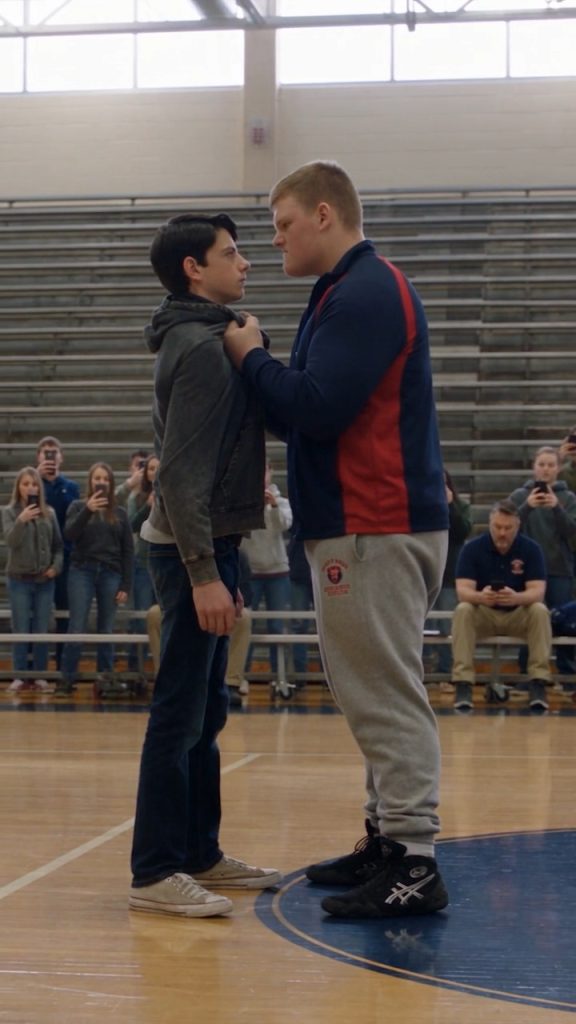
“Don’t thank me yet.” She put the book down and rubbed the edge of the phone case. “I’m afraid if I give it to the school, he’ll know it was me. If I post it, everyone will share my angle. They’ll pick through every second and start messaging me. I don’t want to be anybody’s channel.”
I wanted to tell her I needed it, that it could change everything. Those words were true. They also sounded too much like a command from somebody who believed his problem entitled him to another person’s choice.
“You can speak to Dean Ruiz privately,” I said. “I asked her to collect originals. But it’s yours. You decide how to handle it.”
Maya watched me for a moment. “You weren’t showing off when you bowed, were you?”
“No. I thought maybe he’d stop.”
“I couldn’t tell what it meant. From where I stood, it looked like you were giving him a second to leave.”
“That’s what I was trying to do.”
“I haven’t decided,” she said.
“Okay.”
“It’s not that I don’t believe you.”
“You don’t have to explain it to me.”
She picked up her book and went to the circulation desk. I stayed by the return cart longer than necessary, staring at a spine with half its title rubbed away. I had just learned that something important existed, and I could not control whether it became part of the record.
I spent the rest of the lunch period in a corner of the library where the windows faced the courtyard. It had been my favorite place since freshman year: a table with one slightly uneven leg, a view of a maple tree and an outlet that sometimes worked. I used to come there to finish assignments before going home. Now I sat with a sandwich in its wrapper, listening to laughter outside and trying to figure out why I felt guilty that another student might have to give up her privacy to help me.
On the notebook page headed WHAT I KNOW, I drew a line between the phrase has the file and the phrase will share the file. They were two different things. So were wants to tell the truth and can risk telling it. The younger wrestler had spoken in front of Brody, but I hadn’t seen him since, and every time I pictured his expression I understood another reason someone might stay silent. I didn’t want my case to become a machine that ground up everyone whose testimony could help me.
At a neighboring table, two students were working on a presentation. One turned a laptop toward the other, and they argued briefly about whether a graph needed a label. I watched them solve the question together, then go back to work. It reminded me that outside the clip, people could still change their minds in small, normal ways. I hoped the school would ask witnesses questions instead of demanding that everyone choose a side in public.
After lunch, I had English with Maya. She sat where she always sat, two rows over, and we both pretended to be interested in a discussion about who gets to tell a story. The irony would have been funny in another week. Our teacher asked why a narrator might leave details out. Somebody said, “To manipulate the reader.” Maya stared down at her notes. I wrote in the margin: Sometimes because a person doesn’t know the details yet.
In the hallway afterward, a teammate of Brody’s leaned toward another boy and said loudly, “He trained for that.”
I stopped. “I didn’t train to attack Brody.”
The boy lifted both hands with an exaggerated grin. “Relax, man. Nobody’s talking to you.”
But he had been. He wanted me to hear it and to understand that even a defensive movement could become evidence of bad intentions if enough people repeated the right sentence.
At three o’clock I found a message from the school office confirming the supervised after-school arrangement. The route went by the west corridor and out toward the main pickup lane. It was a normal route. I had walked it dozens of times. Now I needed a written arrangement and a named adult to get there without wondering whether somebody would be waiting.
My mother called during a break. I told her what the dean had said about the scholarship. She asked whether I’d explained the difference between the original recordings and the circulating clip. I told her I had and that a student might have longer footage.
“Does she want to share it?”
“She isn’t sure.”
“Then don’t ask her to be brave on a schedule that suits us,” Mom said. “You can ask the school to protect witnesses. That’s the adult job.”
“I wasn’t going to pressure her.”
“I know. I’m reminding myself as much as you.”
We were quiet for a minute, connected by the scratchy sound of a workplace phone in a small back room. Then Mom said, “How was chemistry?”
“Bad.”
“Because of the test?”
“Because I got an easy question wrong.”
“That happens on bad days. We can talk about homework after dinner.”
Her ordinary question was a gift. It implied there would be a Thursday and a Friday with problems that had nothing to do with Brody Keller.
At pickup, a staff member waited near the west corridor. No one blocked the path. I should have felt triumphant walking through it. Instead I felt watched. The glass doors reflected my hoodie and my too-alert face. I turned once to make sure the hallway behind me was empty.
That evening I tried to study. I made a grid of what I knew, what I had seen and what other people had said. The grid helped me notice the gaps. I knew the younger wrestler had heard an order to block the doors, because he’d said so in front of the coach. I didn’t know his name. I knew Maya had begun recording during the collar grab, because she’d told me. I didn’t know whether her file would ever reach Dean Ruiz. I knew Coach Miller had looked up only after Brody fell, because he’d confirmed it. Nobody could use his reputation to turn an unseen beginning into an eyewitness account.





