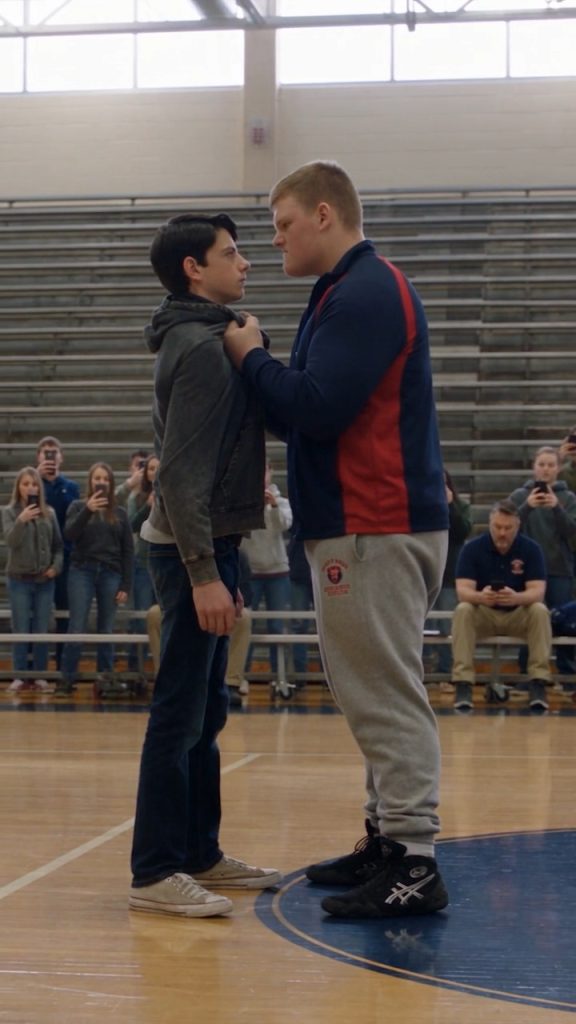
I thought about the difference between what I could do and what I couldn’t. I could provide my own statement and tell the dean about concerns I personally experienced. I couldn’t promise Noah his friends would support him. I couldn’t make Sarah’s name disappear from every chat. I couldn’t turn Maya’s camera into an all-seeing witness. What I could do was avoid treating those people as instruments of my case. The fact that they had chosen to speak meant something precisely because the choices were theirs.
That afternoon I completed a practice test in the library. I hadn’t expected to care about my score, but halfway through I became stubborn about getting an answer right for its own sake. The problems weren’t about character or reputation. They were about quantities that stayed put when you rearranged them correctly. I finished with several minutes to spare and was almost embarrassed by how proud I felt of such an ordinary achievement.
By Friday afternoon, the school had pieces that fit together without becoming one perfectly polished story. Maya’s camera had a clear location and an uninterrupted stretch of the confrontation. Sarah had rejected the excuse made in her name. Noah had described an instruction he heard and the part he played. The coach had admitted where his knowledge began. Two other recordings covered additional seconds from other angles. My own chronology was already on file.
Yet the hallways were still full of guesses. Students asked why Brody wasn’t simply apologizing, why I wasn’t apologizing, why Dean Ruiz couldn’t decide immediately if there were videos. Somebody said there would be suspensions by Monday. Somebody else said the school would never punish a team captain. Those predictions canceled each other out, but they made a constant noise around every ordinary lesson.
In the last class of the day, I found I could finally finish a chemistry problem without starting it over. I had been treating every piece of attention as a threat. Concentrating on a question with one answer felt almost luxurious.
At dismissal, Dean Ruiz asked me to stop by for two minutes. Her desk held a stack of folders, but she kept them closed when I entered.
“Brody has disputed your description of the bow and the physical contact,” she said. “We will give both of you a separate chance to answer questions about those moments next week.”
“What does he say the bow meant?”
“He believes you challenged him. He also disputes the amount of force and whether your actions were necessary. I’m telling you the scope of the disagreement, not asking you to negotiate it with him.”
I stared at the closed folders. I had bowed because I wanted a pause. I had kept my hands open because I wanted everyone to see I wasn’t looking for a fight. Now even that gesture was being turned into a reason I might deserve blame.
“Does Maya’s video show my hands?” I asked.
“It shows important portions of the sequence. We still have to evaluate it alongside the accounts, including the parts a camera cannot show.”
I understood that answer by now, but understanding didn’t make it easier.
I left her office with the uneasy knowledge that evidence did not interpret itself. It had to pass through people—some afraid, some defensive, some trying to be fair. And the moment in which I had tried hardest not to fight might become the very moment Brody used to argue that I had wanted one.
On Monday, October 26, Dean Ruiz asked me to tell the story again without using the word bully.
I didn’t understand why at first. We were sitting across from each other in her office, a glass of water on the table between us, and I had already said everything I knew. The same four minutes had been picked apart for nearly a week. Taking away a word felt like taking away the shape of what had happened.
“I’m not telling you the behavior wasn’t bullying,” she said when she saw my face. “I’m asking for descriptions instead of conclusions. If you say ‘he trapped me,’ tell me exactly where he stood. If you say ‘he attacked,’ tell me what he did with his body. Then we can explain the conclusion without relying only on a label.”
I looked at the grid in my notebook. “Brody stood between me and the center court. He had my collar in his fist. The JV boys stood across the locker-room doors. I could see the west hall exit, but I’d have had to move past Brody or cross the floor while he was pulling me.”
She wrote the answer down. “Could you physically leave through the west exit before he grabbed you?”
“Maybe. I was trying to walk across the gym when he stopped me. After he grabbed me, no.”
“Did you tell him you wanted to leave?”
“I told him I wasn’t looking for trouble. I asked him to let go.”
“What made you think he was going to strike?”
“His arm came back. His weight shifted. I’ve practiced noticing when someone is about to move.”
“Is that something you learned at your movement class?”
“Yes. But it’s not a fighting club. We practice balance and ways to avoid getting hurt.”
The word practice made me worry again. I imagined the group chat hearing that I’d trained since I was eleven and deciding that I had entered the gym looking for a chance to demonstrate it. I told Dean Ruiz I had never been in a school fight before. She said she would note that if relevant, but she didn’t pretend a person had to be helpless to be allowed to defend himself.
I asked whether her questions meant the school might decide I’d planned the whole thing because I had practice keeping my balance. Dean Ruiz considered her answer before speaking.
“Knowing how to move doesn’t by itself tell us whether an action was defensive or aggressive,” she said. “We’re considering what happened before your movement, what you did, and whether you continued once the immediate danger ended.”





