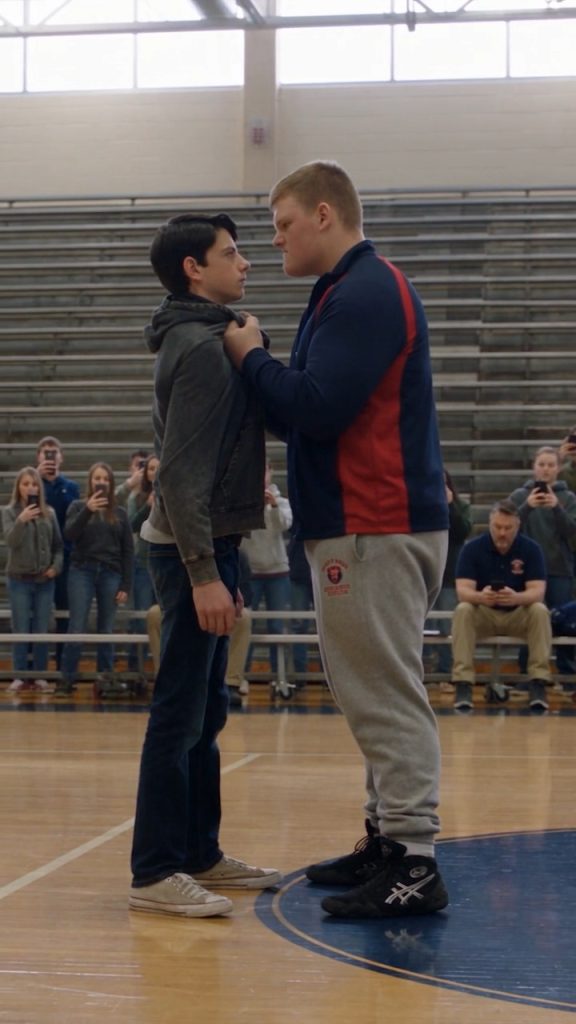
Mom asked what the school would do if witnesses were pressured. Ms. Brooks described a confidential route to Dean Ruiz, monitoring of school spaces and the expectation that coaches would not use playing time or team standing to punish cooperation. She didn’t say fear could be erased by a rule. She said reported retaliation would be handled as a separate concern.
When the meeting ended, Sarah was outside the office waiting for a different appointment. She held a folder against her cardigan and looked surprised to see us. Mom went ahead to the reception desk so we could pass without feeling trapped in a conversation.
“Did you talk to them?” I asked Sarah.
“Yesterday.” She tucked hair behind one ear. “I told Dean Ruiz I never asked Brody to protect me from you. I told her where I was sitting and what I saw. That’s it.”
“Thank you for being clear.”
“I’m mostly angry that he used my name as an excuse. People keep asking whether I like one of you.” She shook her head. “I don’t owe anybody an answer to that.”
“No,” I agreed. “You don’t.”
“Good.” She relaxed a little. “Also, for the record, I had asked you about chemistry because you understood the assignment. That was the entire scandal.”
“Pretty serious scandal.”
She almost smiled. “Terrible. Somebody might learn something.”
For a while I remained beside the trophy case. A picture of last year’s wrestling team hung above a shelf of awards. Brody was in the front row, arm around another student’s shoulder, looking proud and harmless in the way photographs make everyone look. That picture had probably been there when I walked past it before Tuesday, and I’d never given it much thought. Now I understood why it had been easy for other students to say they knew the captain well enough to dismiss my account. They knew a piece of him that wasn’t the same piece I’d seen.
Sarah hadn’t asked me to reconsider him or to hate him more. She’d insisted on the narrow truth about herself. It occurred to me that her refusal protected something beyond my case: her right not to have every ordinary conversation turned into a contest between boys. I could be grateful without expecting her to stay beside me while the school decided. I wished the people passing that trophy case would learn to make the same distinction.
We walked in opposite directions. The conversation didn’t turn into friendship or romance. It ended where it needed to: with Sarah making it clear that Brody’s claim about her was not a statement of her wishes.
A little after noon I learned the younger wrestler’s name. I was returning a library book when he came out of the counselor’s hallway. He had short tight curls and a maroon practice shirt under his jacket. The staff member who had been walking with him continued toward an office, leaving us briefly alone near a bulletin board of college visit dates.
“I’m Noah,” he said before I could ask. “Noah Price.”
“Eli.”
“I know.” His mouth twisted. “Everyone knows.”
He glanced toward the door, as if he expected somebody to appear. I waited rather than asking him about his meeting.
“I wrote down what he told us,” Noah said. “Not stuff I heard from anybody else. He said to take the space by the locker doors before you came through. I stood there. I shouldn’t have.”
“Thank you for telling the dean.”
“I told Coach Miller first. Then I told the dean today. She asked me to sign the statement after I read it.”
“I heard you the first time.”
He looked at me. “You did?”
“Everybody heard you.”
“That’s what I’m worried about.” His gaze dropped to the carpet. “My friends were right there. Brody was looking at me.”
I could still see the captain’s expression, the warning in it. “You don’t have to talk to me about it,” I said. “I don’t want anybody thinking I told you what to say.”
Noah’s shoulders loosened by a fraction. “Okay.”
“You can tell Dean Ruiz if somebody makes this harder.”
“I know. She said.”
He took one step away, then turned back. “I couldn’t see everything by the bleachers. There were guys in front of me. I just saw him go toward you and then go down. I wrote that too.”
“That’s fine.”
“It’s not the whole story.”
“No,” I said. “But it’s the part that’s yours.”
He left down the corridor without giving me a heroic look or asking for my forgiveness. I didn’t follow him. If I wanted his account to matter, I had to give him room to own it.
For several minutes after Noah left, I stayed beside the bulletin board pretending to read a college visit schedule. I didn’t know whether anyone had seen us speak or what they might infer. I also didn’t know whether Brody had personally threatened him outside the gym. My mind kept wanting to supply a dramatic answer. It was easier to picture a single villain giving explicit orders than to accept how ordinary social fear could work: someone laughs, someone refuses to sit next to you, somebody decides you are unreliable before you have said another word.
I went to the student commons, where three boys in wrestling warm-ups were studying at a table. They weren’t watching me. One asked another for a pencil, and an argument broke out over whether the loaned pencil was ever returned. I could have been looking at any group of students on any Friday. Then I saw the same maroon color as Noah’s practice shirt and felt my pulse speed up. I wasn’t proud of it, but I didn’t blame myself either. My body was responding to patterns it had learned only days before.





