“You remember what we said?” Mom asked.
“Ask what the decision means. Ask what happens next.”
“And listen before we decide how we feel.”
We went inside together.
Dean Ruiz sat at the conference table with Ms. Brooks. Neither was smiling, but neither looked grim. There were two folders on the table. One remained closed throughout the meeting; the other held a written summary that Dean Ruiz turned toward us.
“We’ve completed the school’s conduct review,” she began. “We interviewed the students involved separately, checked the timing and visible actions in the recordings voluntarily supplied, and considered the statements of witnesses who were in different parts of the gym. We also reviewed the supervision concerns. I want to explain the findings and the steps we’re taking, then give you both a chance to ask questions.”
I held the edge of the chair beneath the table. It was a habit I’d picked up that week. If my hands stayed occupied, they wouldn’t shake as much.
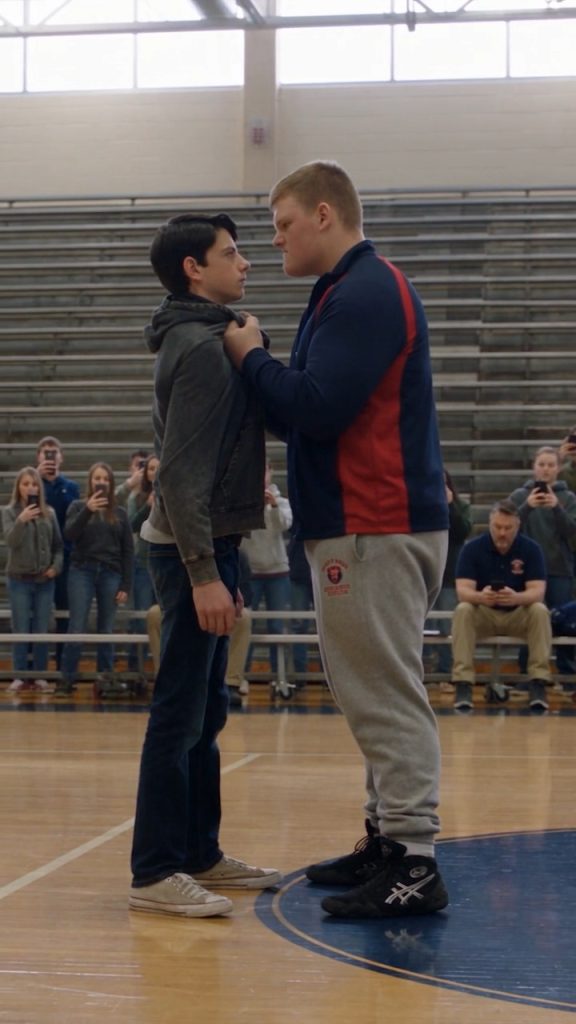
“First,” she said, “the school finds that Brody Keller initiated the physical confrontation by grabbing your clothing and shoving you against the bleachers. He had previously directed junior-varsity teammates to occupy the locker-room doorway. The evidence supports that this was a coordinated act of intimidation, not an accidental meeting in the gym.”
The sentence landed quietly. There was no music, no crowd gasping. I heard a radiator click and somebody walking in the hall outside.
Dean Ruiz continued. “The evidence also supports that Brody moved aggressively toward you twice after you freed your collar. The first time, you moved out of his way and did not continue contact. The second time, you briefly restrained and redirected him to the floor, then released him and stepped away. We considered your description of your training, your warning and your bow, and the visible sequence before and after each movement.”
I was almost afraid to breathe.
“We do not find that you initiated a fight or used your movements as retaliation,” she said. “Your actions were defensive in the context of the immediate threat. There will be no school discipline against you for this incident.”
Mom’s hand found mine under the table. Neither of us spoke.
Dean Ruiz gave us time. Then she added, “We also find that Brody’s claim that you attacked him without warning was not an accurate account of the encounter. The words came after a sequence that he omitted.”
I stared at the paragraph on the page. It said, in careful school language, something I’d been trying to make people understand since the gym. The beginning mattered. The ending mattered. The space between them mattered too.
“What about my scholarship?” I asked.
“Your merit scholarship remains in place,” she said. “There is no misconduct finding against you, and there is no scholarship action arising from this event.”
My mother let out a breath she seemed to have been holding since Tuesday evening. She asked whether that confirmation could be included in our copy of the school’s letter. Dean Ruiz said it would. It wasn’t a dramatic promise about my whole future. It was a simple, specific answer to a fear that had kept me awake.
Ms. Brooks explained the athletics decision without showing us another student’s private disciplinary file. Brody was being removed as varsity wrestling captain for the remainder of the season. He would also be restricted from athletics participation for ten school days, with conditions for returning that addressed conduct and supervision. Dean Ruiz confirmed that Brody would serve a two-school-day suspension. She was careful to distinguish the general school consequence from the athletics decision.
“I know you may want more details,” she said. “We can confirm the measures relevant to your safety and this finding. We won’t distribute another student’s private record, just as we won’t distribute yours.”
I tried to imagine Brody hearing the same information in a different room. I didn’t know whether he would be furious, embarrassed or convinced the decision was unfair. None of those possibilities changed the facts. For almost ten days, his reputation had seemed like the only reputation the school wanted to protect. Hearing that there were limits to what a captain could do mattered more than imagining his reaction.
Still, part of me wanted an audience. I wanted the faces in the bleachers to see that the boy they’d called a charity case hadn’t been the one looking for a fight. Then I remembered Maya worrying about her video and Noah wondering whether he’d lose his place on the team. A public spectacle could injure them without giving me anything I truly needed. The finding was for the school to act on. I didn’t need to put every person who helped in front of another camera.
“I don’t need to see everything,” I said. The truth surprised me. Two weeks earlier I’d imagined that justice would feel like watching Brody embarrassed in front of the same thirty people who had watched me. Now I mostly wanted to know he wouldn’t be able to repeat what he’d done and call it a joke.
“What about the boys at the doors?” Mom asked.
“Each student’s involvement was reviewed individually,” Ms. Brooks said. “Those who knowingly participated are receiving corrective consequences. We took account of the differences between directing the conduct and following a direction, and of cooperation afterward. The students remain responsible for what they did, including the younger witness who acknowledged his participation.”
“Will speaking up cost him his place on the team?” I asked, thinking of Noah.
“Cooperating with a school review is not a reason to remove a student from athletics,” Ms. Brooks said. “Individual corrective action still applies where appropriate. The coaches have been instructed to report any concern about retaliation or unequal treatment.”
She didn’t promise that Noah would suddenly be popular or that teammates would never be unkind. She told us what adults could actually monitor and correct.





