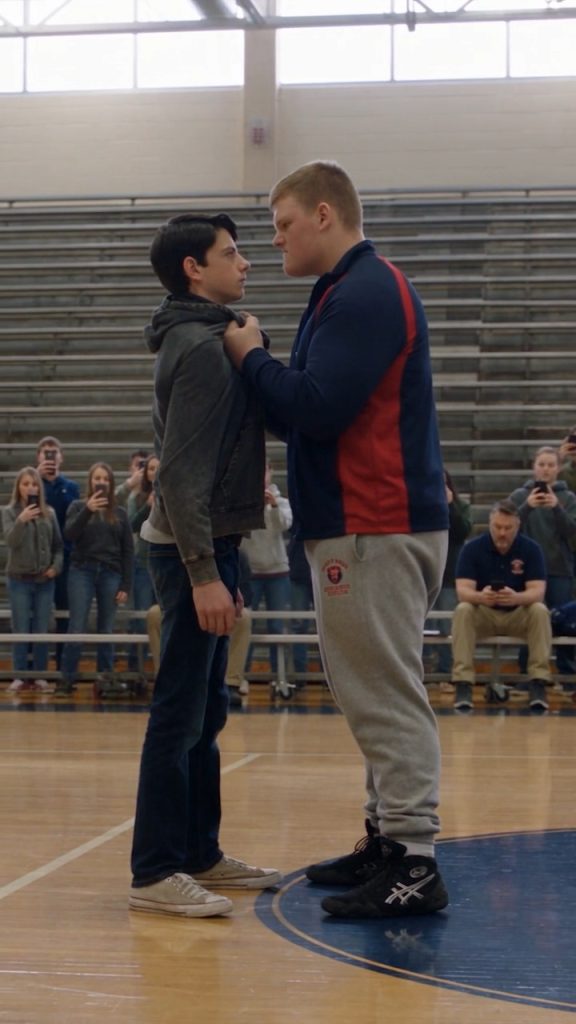
The more carefully I wrote, the more I realized that the evidence wasn’t a single perfect thing. It was people holding pieces of a story they might be afraid to surrender.
An email from Westridge arrived just after nine. It confirmed the temporary no-contact arrangement and supervised gym transitions. It also said the review remained open, that students and guardians would be contacted as needed, and that retaliation or pressure against witnesses should be reported promptly. Mom read it aloud once to make sure we hadn’t missed anything.
“That’s good,” she said.
“It means they haven’t decided.”
“That’s true too.”
I set the phone face down, but it buzzed again with a message from the group chat. A new caption had been attached to the cropped video: THEY’RE MAKING BRODY THE BAD GUY FOR LOSING.
I didn’t open the replies. The sentence was enough to show me the shape of the next problem. A few people were willing to treat the fall as proof Brody had been harmed, even if the part before the fall had been cut away.
On paper, the school was giving me a protected path through its halls. Online, there was no corridor that people couldn’t crowd.
Maya had told me an original recording existed. Dean Ruiz had said she would seek it. Those were promising facts, but a promise of a fair process was still only a promise until somebody made a hard choice.
I looked at the legal pad by my desk, read the sequence I’d written and decided I would go back to the dean the next morning, even if nobody else came forward. If the first version of the story to spread was going to be wrong, I would at least make sure my own version was recorded accurately.
The hall at Westridge would be open again at eight. So would the questions waiting for me there.
On Thursday I went back to Dean Ruiz before my first class, carrying the same legal pad and no new proof.
She was unlocking a filing cabinet when I reached her office. The hall smelled of fresh coffee and rain dampened coats. Outside, a cold front had rolled through overnight, and the trees in the parking lot kept shaking loose yellow leaves.
“I wrote another page,” I said.
She motioned me to a chair. “What changed?”
“Nothing about what happened. I separated what I saw from what I heard afterward. I thought it might help.”
I showed her two columns. One contained observations from Tuesday: Brody’s hand on my collar, the pressure against the bleachers, the first rush, the second. The other contained things other people had said, including the JV wrestler’s statement about the door and Maya’s description of her video. I had written next to those: Not personally witnessed before the incident.
Dean Ruiz read it carefully. “This is useful, Eli. It helps us avoid treating one person’s memory as a view from everywhere in the room.”
“Do you have the longer video?”
“We’re arranging to speak with students who may have it. I can’t tell you what another student will choose to share.”
I almost told her Maya’s name. Then I remembered the promise I’d made in the library, and the fact that the dean was already asking people for footage. If Maya wanted to speak privately, my job wasn’t to get there first with her name.
“Okay,” I said. “But could you make sure they know they don’t have to show it to a crowd?”
“That is precisely what we’re trying to do.”
During second period, Maya asked to leave English class. She carried her phone and a small notebook. I didn’t follow her with my eyes, even though I knew half the room did. A boy two desks behind me whispered, “Here comes the documentary.” The teacher continued talking, which spared Maya the experience of becoming the subject of a public correction.
At lunch she found me beside the side door to the library. No one else was close enough to hear us.
“I gave Dean Ruiz a copy,” she said.
I felt a surge of relief so strong it almost made me dizzy. “You didn’t have to tell me.”
“I wanted to. I showed her the file on my phone first, then transferred the whole thing through the school’s private upload link. She wrote down where I was standing and when I started. I kept the original.”
“Did she say what it proved?”
“She said she wasn’t deciding anything just from one recording.” Maya’s eyebrows rose. “Apparently, she is very committed to saying that sentence.”
I laughed for the first time since Tuesday. It startled both of us.
“What did you think when you watched it?” I asked.
She looked over my shoulder toward the hallway. “I thought Brody was bigger than you even on the screen. I thought the first time you moved, you were trying not to be where he was going. And I thought the moment after he hit the floor was more important than people realized.”
“Because I let go?”
“Because there was a pause when you could have kept doing something, and you didn’t.”
I had never considered a pause as a piece of evidence. In my mind, it had simply been the instant I wanted to escape.
“Did you post it?” I asked.
“No. And Dean Ruiz agreed the school should ask students not to circulate more versions. I don’t know whether that will work.”
“Probably not completely.”
“I know.” She gave a small, unhappy smile. “That’s why I didn’t want to be the person uploading it to everybody.”
The copy was now in adult hands, but Maya would still walk through the same hallways as Brody’s teammates. I thanked her once, without turning it into a promise that the world would be kinder. She nodded, then asked me whether I’d finished the English reading. We spent five minutes discussing a narrator who hadn’t understood the consequences of something she said. It was a relief to be two students talking about homework rather than two pieces of an investigation.





