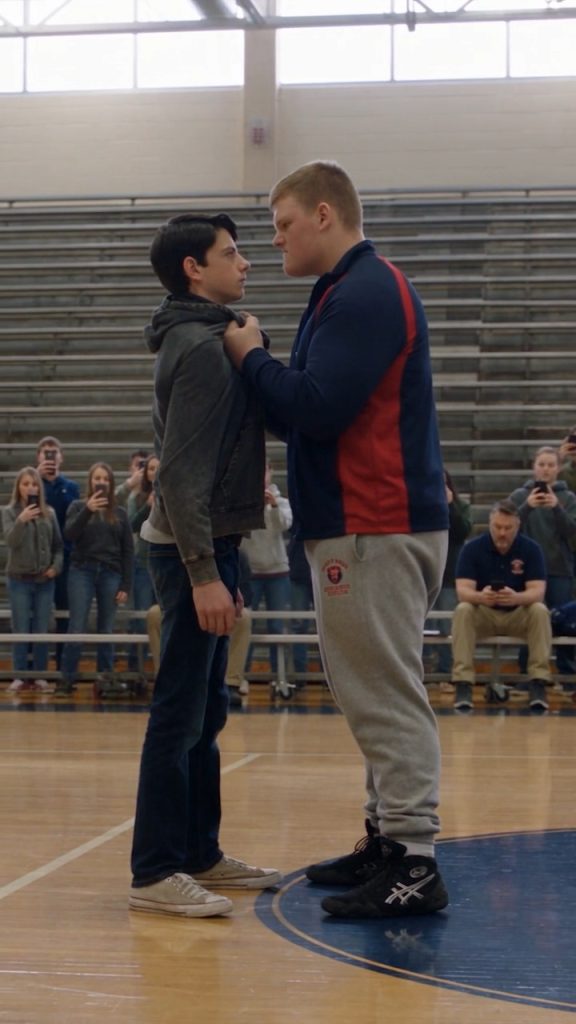
The lower bleachers were visible through a glass panel in the corridor outside the science wing. Students used that corridor to reach the gym offices and fitness rooms, but I had no reason to go there before dismissal. Still, when a group of athletes came around the corner, I moved closer to the wall. There were only two of them. Neither was Brody. Neither even looked at me. My body didn’t care about those details yet.
At lunch I found Dean Ruiz waiting in her office with a printed copy of the schedule for the next few school days. She had closed the door but left the window beside it uncovered. She asked about my throat. I told her it felt normal. She asked how I was sleeping. I said not well.
“That’s useful to know,” she said, making a brief note. “You aren’t in trouble for describing the effects of this.”
I took the legal-pad pages from my backpack. I’d numbered them because I was worried loose sheets would be rearranged. She read the top one, then asked if she could copy them for the incident file. I agreed and kept the originals.
“I have one addition,” I said. “The video people are sending around starts after the first charge. It isn’t the whole incident.”
“I’ve been told about that clip. We haven’t established who made it or how it was edited.”
“Could you ask for the original recordings? They were filming before he pushed me.”
“We’re asking students to share anything relevant privately and to explain when they started recording. We can’t assume everybody has the same view.”
I took out my phone and showed her the version I’d received. Her expression didn’t change as she watched it. She replayed the last second where my hands left Brody’s arm.
“What’s the part this clip doesn’t show?” she asked.
“His first rush. And what happened before both rushes. I had told him to leave me alone. I didn’t hit him.”
“We’ll document your description. We also have to give Brody a chance to respond to it.”
I nodded. Fairness sounded less comforting when it included the person who had lied about you. But I knew I wanted the same opportunity to be heard, and I couldn’t demand a process that only worked for me.
She explained the immediate arrangements. During the review, Brody and I were not to approach or contact each other. An adult would supervise after-school movement around the gym. We could report concerns directly to her office or through a school counselor. She was careful to say that the temporary separation wasn’t a finding against either student.
“Am I allowed to be in the gym?” I asked.
“For scheduled classes, yes. You won’t be required to pass through a group of wrestlers unattended at dismissal. We can work out a route you feel comfortable using.”
“What about my scholarship?”
She put her pen down. “An allegation isn’t the same as a disciplinary decision. Your academic merit award is handled by a separate office. I can’t predict the outcome of a review that isn’t complete, but there’s been no decision to change your scholarship.”
I had wanted her to say it was impossible for that to happen. She refused to promise what she couldn’t know. That made the answer less satisfying and more believable.
“Do I have to keep my grades up through this?” I asked, trying to make a joke of it.
“You should keep learning, Eli. And you should tell your teachers if concentration is difficult. Those two things can both be true.”
When I left her office, Coach Miller was standing at the far end of the hall near the athletic department’s door. He wore the same navy staff polo, now under a windbreaker. I slowed automatically. He recognized me and came a few steps forward, leaving a respectful distance.
“Eli,” he said. “I want you to know I’ve given my account.”
“What did you see?”
He looked exhausted. “I saw Brody on the floor. I saw you standing away from him. That’s when I realized there had been a physical incident.”
“You didn’t see him grab me?”
“No.”
“Or rush at me?”
“No,” he said again. “I heard the disturbance late. I’m sorry I wasn’t paying attention sooner.”
I had rehearsed an angry speech about adults and responsibility. His direct answer left me holding it with nowhere to put it. I didn’t forgive him because he apologized. I also couldn’t accuse him of seeing something he’d admitted he hadn’t seen.
“People keep saying you know Brody would never start a fight,” I told him.
“I haven’t said that.”
“They say you’re his coach.”
“I am. That doesn’t make me a witness to what I missed.”
He shifted aside so I could pass. Before I went, he added, “Please keep talking to Dean Ruiz. She needs the actual sequence.”
I walked toward the library with a feeling I didn’t know how to name. The coach had failed me in the moment when an adult was supposed to notice a problem, but at least he wasn’t turning that failure into false certainty. It was a small distinction with an enormous practical difference.
In the library, I met Maya Patel by accident near the return cart. She had a book balanced against her backpack and her phone in the green case under one palm. She saw me, then glanced toward the circulation desk.
“Can I tell you something without you making me do anything right this second?” she asked.
“Yes.”
“I started recording when he already had your hoodie. I didn’t stop until after Coach Miller stood up.”
It took me a second to understand what she meant. “The whole time?”
“From the collar grab. Not before it. You can hear parts of what Brody says. People are talking over it, so not every word.”
“Have you posted it?”
“No. I haven’t sent it anywhere.”
I thought of my own face on thirty screens and the unending messages in the class chat. “Thank you.”





