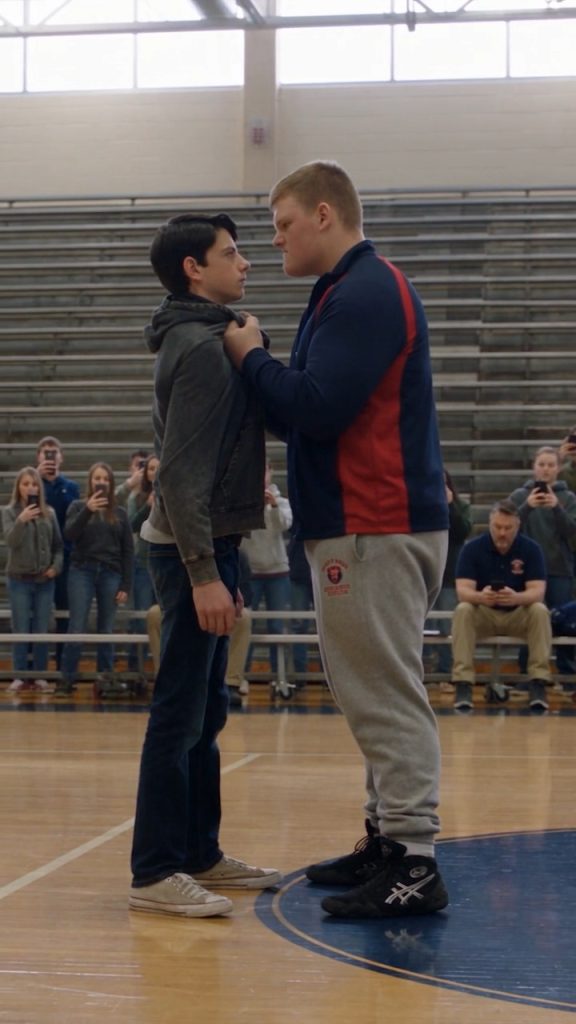
Mom saw my face change. I set the phone between us and played it once. She watched without touching the screen.
“Is that all of it?” she asked.
“No.”
“Then write that down too.”
I added one more line to my notes: A short clip is circulating that starts after Brody’s first attack. I don’t know who edited it.
The video repeated automatically, stopping again with Brody on the floor and me stepping back. The image was factual in the narrowest possible sense. Every frame in it had happened. It was the missing frames that made it feel like a lie.
That night I left the hoodie over the back of my chair instead of folding it into the drawer. The collar hung stretched and uneven. I wanted to forget what the bleachers felt like against my spine, but I knew that forgetting would make room for someone else’s version.
On my phone, the short clip kept spreading. On the legal pad, the first line of my account remained where I’d written it: Brody grabbed my sweatshirt before I touched him.
For the first time, I understood those were two different battles.
By Wednesday morning, the clip had acquired a life that had very little to do with the gym.
Someone had put the words WRESTLER GETS DROPPED above it. Someone else had added a laughing face. In the chemistry chat a student asked whether I was getting expelled, then deleted the question and replaced it with a question mark. Nobody had contacted me to ask where the video began.
I watched the school buses turn into Westridge’s driveway through the passenger window of Mom’s car. She had arranged to start her shift a little later, which meant she’d have to make up the time. She didn’t mention that cost. Her fingers rested on the steering wheel while cars rolled around us.
“You can still tell me you’d rather stay home,” she said.
“And have everybody decide the video is the whole story?”
“That’s not a reason to walk into something unsafe.”
“I know.” I studied the brick wall beneath the Westridge sign. “But I think I need to be there. Dean Ruiz said someone would help with getting through the gym area.”
She looked at me for a long moment. “Then you tell her exactly what you need. Not what you think makes you seem brave.”
Inside the school, ordinary Wednesday noises felt offensive. A vending machine rattled. Two ninth graders argued over whose calculator they’d borrowed. The ceiling above the hallway looked the same as it had before Tuesday. I wanted it to look damaged somehow, to acknowledge what had happened beneath the same roof.
Near my locker a boy from my algebra class lifted his chin. “Didn’t know you had moves, Moreno.”
“It’s not something I wanted to show anyone.”
He smiled as if that were part of a joke and walked away.
A girl passing us whispered, “Brody says he was just messing around.”
I was reaching for my books when she said it, and my hand stopped on the locker handle. I’d been pressed against steel bleachers hard enough to feel their ridges through a sweatshirt. I thought of thirty people holding cameras. Messing around was a phrase that could erase another person’s fear without having to prove anything.
The lockers closest to mine belonged mostly to juniors who went to games together. On ordinary mornings their arguments were about parking, music and whether cafeteria fries counted as lunch. That Wednesday they spoke more softly while I opened my lock. I caught fragments about the captain and about whether the floor had been slippery. Nobody seemed sure whether I was a victim, a threat or a short video they could laugh about.
I had never been close to Brody. We’d shared the gym during school assemblies and passed each other at lunch. Once, months earlier, he had moved my backpack off a cafeteria chair and announced that the team needed the table. I had picked up my things and sat by the windows without making a scene. At the time, the exchange had seemed too small to complain about. Remembering it now, I wondered how many small permissions I’d given him by choosing not to argue. I tried not to punish myself for that thought. Being polite in a cafeteria didn’t make his later decision reasonable.
The teacher’s opening question came from the board: solve a system using substitution. I knew the method. My thoughts kept slipping sideways into the gym, as if the bleacher edge were still against my back. Every time a chair scraped, I turned my head before I could stop myself.
In first period I made a mistake on an equation I would normally have solved in my head. I checked the multiplication twice and still got it wrong. The teacher leaned beside my desk and quietly asked whether I needed a counselor. I said I had a meeting with the dean at lunch. She nodded and moved on without making me explain it to the class.
At the end of the period, Sarah crossed the aisle toward me, then stopped when two students behind her began whispering. She adjusted the strap on her bag and said, “I didn’t ask him to do that.”
I met her eyes. “I didn’t think you did.”
“Good.” She seemed to have expected an argument. “Because people are telling me this was some kind of fight about me. That’s not happening.”
“I know.”
Her mouth tightened. “I’m going to tell Dean Ruiz what I saw.”
“You should tell her what you know.”
That was all. She left before anybody could turn our conversation into a new rumor. For the first time that morning, my shoulders lowered a fraction.





