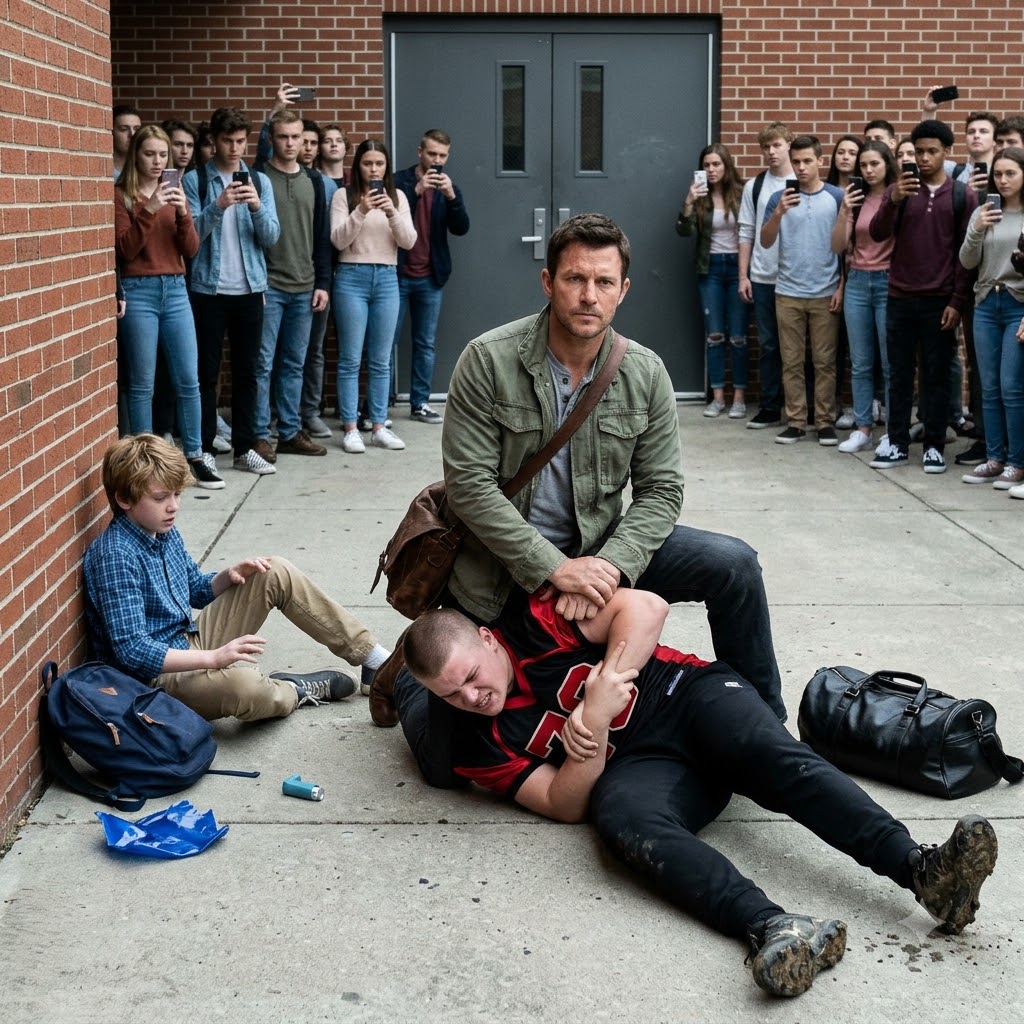
The inhaler was in Marcus Thorne’s right hand, so high above his head that Toby Hendricks might as well have been reaching for a branch at the top of an oak tree.
Toby stood with his back against the gym wall. His brick-red hoodie had slipped off one narrow shoulder, and his mouth opened and closed around breaths that weren’t arriving properly. He was fourteen, ninety pounds on a generous scale, and had severe asthma. Marcus, at eighteen, was six feet four and weighed two hundred sixty-five pounds. The boys around him had already taken turns passing the inhaler over Toby’s head. Now Marcus held it himself, smiling for the audience.
It was Thursday, October fifteenth, a windy lunch period at Oak Creek High. Nearly three hundred students occupied the courtyard, though fewer than that were watching. I left my coffee on the concrete planter and crossed the paving toward the gym.
“Marcus,” I said.
He looked over, not lowering his arm. “What’s up, Mr. V? We’re just messing around.”
“Hand him his inhaler. Immediately.”
A few conversations stopped. Toby took one step toward Marcus and had to brace a hand against the brick again. Marcus’s teammates shifted back toward the crowd. A couple of students raised their phones.
“Or else what, teach?” Marcus asked. He liked that word. It made my job sound like a costume I could be ordered to take off. “Gonna write me up? Coach Miller will tear it up.”
“I’m concerned about Toby breathing,” I said. “Give it back.”
Marcus looked at me for a moment, then at the phones. I watched him make a decision. His hand opened, and the inhaler fell beside his right cleat. Before I could reach it, he pressed the black Nike shoe down and twisted.
Plastic cracked against concrete. Toby made a small, thin sound.
Then Marcus turned and hit me.
The punch landed against the left side of my chest. I did not see enough of his movement to prepare for it. My body folded around the impact, and the paving struck me hard. For a few seconds the courtyard became a place made of scattered impressions: a shoe near my face, wind carrying a lunch wrapper, the rough grit under my right hand, a terrible pressure where my ribs should have moved freely.
Someone screamed. Marcus told me to stay down.
He had every reason to expect I would. I was thirty-nine, five feet ten, perhaps a hundred seventy pounds after a large breakfast, and I taught eleventh-grade English. My students knew my brown cardigan and my habit of writing questions in the margins of their essays. They did not know much about the seven years before I came to Oak Creek, and very little about the years before that.
I planted my right palm on the concrete, kept my left forearm against my ribs, and tried to get one knee under me. Marcus’s shadow moved across my hand. The motion cost more than I had anticipated. My body wanted me flat on the pavement. I stood anyway.
The courtyard fell quiet enough for me to hear Toby trying to breathe.
I stepped close to Marcus. He had lost his grin. I brought my mouth near his ear, where only he could hear, and said, “Seven years ago, I would’ve killed you for something like that. But today, I’m simply going to take your whole life apart.”
His expression changed. For one shameful instant I felt satisfaction. I had made him afraid.
Then Toby coughed against the wall, and that instant ended.
“Someone get the nurse,” I called, louder than I’d spoken all afternoon. “Tell her Toby Hendricks is having trouble breathing. Someone else call the office. Now.”
A girl near the benches hurried toward the main doors, already speaking into her phone. I pointed to another student. “You. Tell them there has been a serious assault and a damaged rescue inhaler. Don’t guess what else happened. Just tell them what you saw.”
Marcus lifted a hand as though he might object. I held up my right palm, not as a threat but to keep him where he was. “Back away from Toby.”
“You threatened me,” he said. His voice carried. “Everybody heard that, right?”
Nobody answered. Nobody could have heard the words from where they stood. The difference mattered, although I did not yet understand how much.
“Stay here until another adult comes,” I told him. “Don’t touch the inhaler.”
He glanced down at the crushed pieces by his cleat. Finally he moved two steps away. I could not know whether he obeyed because of my voice, the cameras, or his own dawning understanding of what he’d done. I only knew he moved.
I went to Toby, careful not to crowd him. “Help is coming,” I said. “Can you sit where you’re comfortable?”
He gave a tiny nod. His eyes were wet and furious, an expression I recognized better than the tears. I wanted to tell him that none of this was his fault. What he needed first was someone who could help him breathe, not another grown-up offering a speech.
The girl returned with a hall monitor, and the monitor radioed the health office while another employee called emergency services. I leaned against the wall a few feet from Toby and concentrated on staying conscious. Every shallow breath reminded me that something inside my chest was wrong.
The nurse arrived carrying a medical bag. She already knew Toby’s name. As she knelt beside him, she asked brief questions and took out the backup inhaler that his guardian had registered with the school before the semester began. I had never been so grateful for paperwork. She followed his care plan, checked his response, and stayed with him while the adults coordinated further medical assessment.
I took two steps toward her. The courtyard tilted.
“Mr. Vance,” she said, looking up, “don’t try to help me by falling over. Sit down.”





