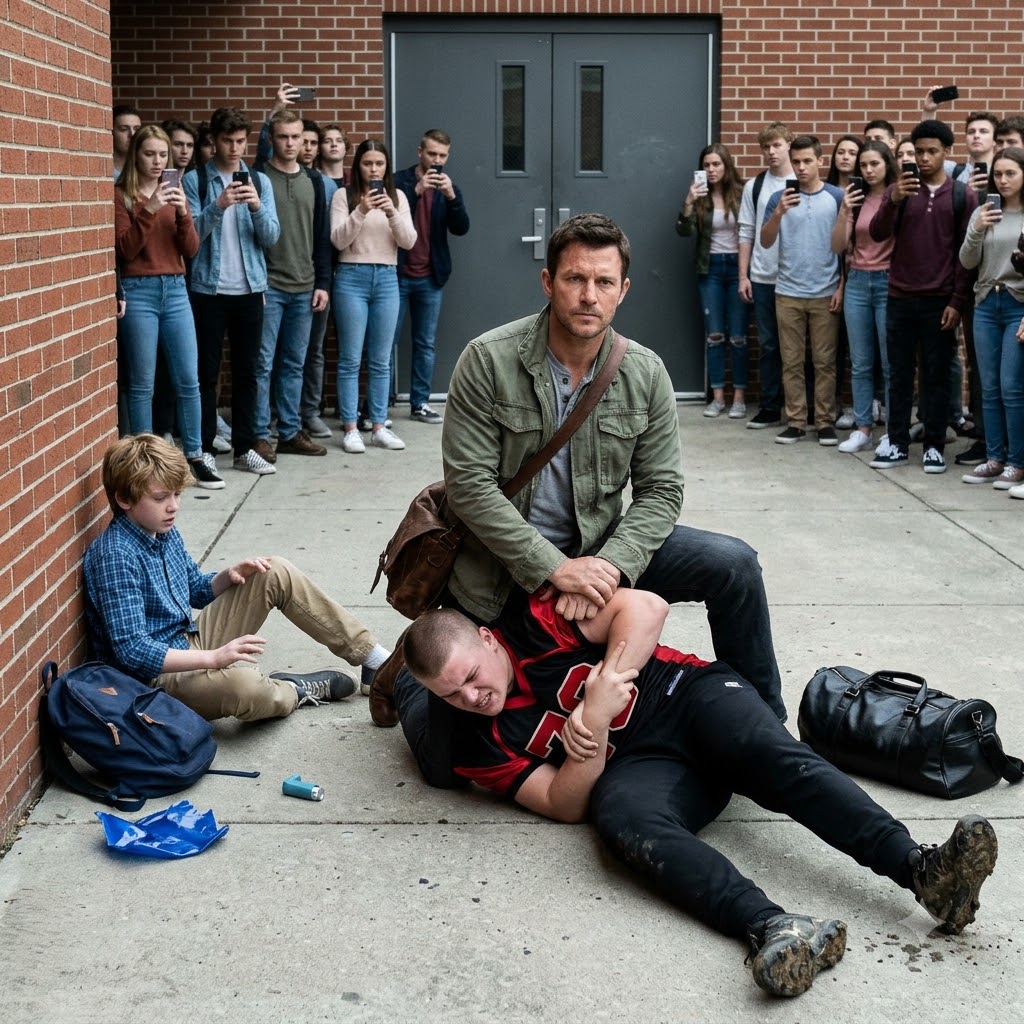
Naomi sat at the small kitchen table while I poured tea. She had supervised lunch in the main cafeteria the day before, and had not witnessed the incident. She told me what colleagues were worried about but resisted filling in what she didn’t know. Some feared reprisals from football families. Others feared a teacher being disciplined for intervening at all. A few had seen only the clipped video in which I seemed to approach Marcus after standing up.
“People keep asking me whether you were about to hit him,” she said.
“I wasn’t.”
“I believe you. But you see why they ask.”
I did. In the footage, my right hand rose briefly between us. The angle eliminated the wall, Toby and the smashed inhaler. There was no sense of which person had crossed the distance first. It was a reminder that video could be accurate and incomplete at the same time.
An email from the district arrived while Naomi was there. It asked recipients not to post or forward recordings of minors involved in a medical crisis and offered a secure route for students and guardians who voluntarily wished to submit original clips. The message did not order children to turn over private phones or claim an unlimited right to seize them. It requested evidence from the people who had actually made it, with the important distinction between original files and copies that had been trimmed, captioned or edited.
“That might help,” Naomi said.
“If someone recorded the beginning.”
“And if whoever has it wants to share.”
We let the conditional stand. It was too early for certainty.
By noon, a message came from Higgins saying that Toby was recovering with his guardian’s support and that the family had asked for privacy. I wrote back only to express relief and to say I would respect the request. I did not ask what medication he’d received, whether he had nightmares, or whether he blamed me for not intervening sooner. I could ask those things of myself. He owed me no answers.
The remote meeting began at two. Higgins appeared in a navy blazer against the pale wall of her office. Beside her on the screen was the district’s student-services director, whom I had met once during a training day. I asked Naomi to sit nearby as a colleague, and she agreed not to answer questions for me.
Higgins first asked about my health. She seemed genuinely disturbed by the injury, but not so disturbed that she stopped taking notes. Then we worked through the chronology. She had been at a district meeting when the punch occurred. Her knowledge came from accounts, medical information I chose to provide, and what staff had documented after they arrived. She did not claim she could fill the gaps by instinct.
“Mr. Vance,” the director said, “your report contains a statement you acknowledge making to Marcus. Do you confirm the wording?”
“Yes.”
“Did you intend to harm him physically?”
“No. I intended to scare him. I am not proud of that, and I understand why it matters.”
“What prevented a second confrontation?”
The question made me uncomfortable. I could have offered my history as evidence that I was more dangerous than I looked. That would merely have polished the threat.
“Toby needed care,” I said. “Marcus had already caused enough harm. I made a choice not to add to it.”
Higgins looked down at her notes. “Thank you for answering directly. We will review the language separately from the student conduct. Neither inquiry removes the need for the other.”
I was relieved and frightened. Separating the issues sounded simple until I imagined how each might be used by people determined to combine them.
I offered my dated notes about previous incidents and explained their limits. Higgins requested a copy and asked whether I had filed formal reports. I told her what I remembered: speaking to one staff member about the September encounter and raising a concern informally after another. I had not completed a formal incident form on either occasion. The admission stung. She asked why not.
“I thought I’d handled the immediate situation,” I said. “And I was told once that football staff would deal with their students. I should have followed up more clearly.”
She did not absolve me. She said the district needed to understand how reports were handled, whether formal or informal, and would not treat my planner as proof of every earlier allegation. I was grateful she made that limitation explicit. A good investigation cannot become fair by replacing one favored account with another.
The conversation ended with a discussion of interim safety. Marcus and Toby were to have no direct contact while the school reviewed events. A staff member would help Toby navigate shared spaces if he wanted it, and the school would make a plan with him and his guardian rather than simply assigning him a shadow. Marcus was temporarily away from school pending the initial process. Athletic participation would be considered separately under the district code, which required an eligibility and safety assessment. Coach Miller could offer information about his team but did not decide the matter alone.
That final distinction seemed small. At Oak Creek it was revolutionary.
When the call ended, I stared at my reflection in the dark laptop screen. I hadn’t had to take off my shirt and show scars. I hadn’t threatened to expose Marcus to anyone important. I had described an event in sentences the school could check. For the first time since the punch, the course of action did not depend on which man was more intimidating.





