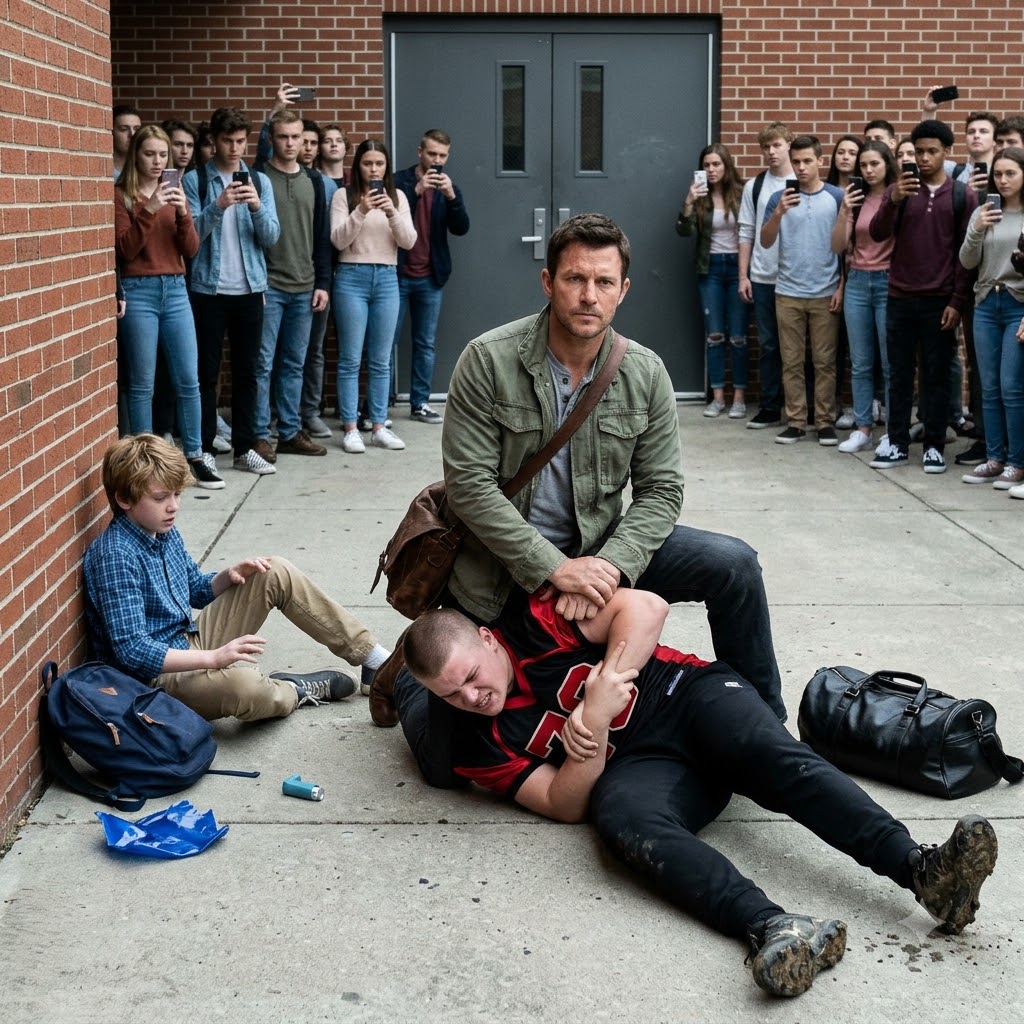
None of the files recorded the whisper. In one frame, Marcus leaned toward me as I rose; in another, my face disappeared behind his shoulder. The camera microphones captured wind, shouting and shoes scraping concrete. It would have been dishonest to claim the videos proved I had never threatened him. That was why I had put the threat in my own report.
“Do these images match your memory?” the director asked.
“What I can see, yes. I can’t verify the beginning of the first handoff. I arrived after Toby’s inhaler had already been passed around.”
“And you cannot confirm who was filming?”
“I can see their viewpoint, not their identity.”
I found the restraint comforting. We were using ordinary standards: what happened, where someone stood, whether one account agreed with another. No one needed to decide whether Marcus was a monster or I was a hero before examining the visible sequence.
The staff photograph of the broken inhaler appeared next. It had been taken after urgent assistance was underway and before the pieces were collected. Marcus had already stepped away. The small object lay beside the dark mark left by his cleat. The photograph did not preserve his intention, but the original clip of his foot descending made that question difficult to treat as accident. The director asked whether I had touched the inhaler after it broke.
“No,” I said. “I stayed with Toby until help arrived.”
She recorded the answer. I understood why. If I had picked it up and moved it, the photograph would still show damage but not necessarily the original location.
The director also asked about the moment before the punch. Marcus claimed I’d pushed into his chest and that he’d reacted to a threat. I told her I had stood close to him and challenged him verbally but had not made physical contact before he struck. A wider clip, although partly obscured, showed the two of us separated when the inhaler hit the ground. My step forward occurred after the assault, while I was rising. The difference was not a question of which man looked angrier. It was a sequence a witness could describe.
When the interview ended, I stayed seated, hands resting on the edge of my desk. I had seen myself fall. That was worse than remembering it. On screen I seemed extraordinarily ordinary, a middle-aged teacher in a cardigan overwhelmed by one blow. There was no hidden athletic grace to reveal. The thought was humiliating, and its power over me surprised me.
I called Naomi and told her that the footage had shown the action more clearly without answering everything. She asked how I felt.
“Smaller than I expected.”
“You were injured.”
“I know. It’s foolish.”
“It’s human.”
We talked for a while about my students. The substitute had managed a productive discussion about ambition and self-invention. One junior had argued that Gatsby’s tragedy wasn’t wanting something too much, but treating other people as scenery while he pursued it. Naomi repeated the student’s words because she knew they would interest me. I sat with them after the call. Marcus had treated Toby as an object in a performance. In the hospital I had nearly treated Marcus as one too, a target whose fear could prove that I remained strong.
Wednesday brought a different kind of evidence. Higgins asked whether I could clarify two entries in my lesson planner. One mentioned a boy with a gray backpack at the auxiliary gym. The school had a name from a separate report, but she did not disclose it to me. She asked exactly what I’d seen and whether Marcus had touched that student. I answered no; I had seen the surrounding posture and heard laughter, but I did not hear the conversation. The other note was about the locker encounter. Again, I described it without embroidery.
“You kept these before the assault,” she said.
“Yes. I used the planner every day. You can see the surrounding lesson notes and dates.”
“Did you show anyone the page?”
“Not then.”
“Why did you keep writing if you weren’t submitting formal reports?”
I considered answering that teachers often record things as memory aids, which was true but incomplete. “Because I thought there was a pattern,” I said, “and I didn’t want to replace what I’d seen with rumor. I should have asked more directly what needed to be filed.”
She noted my answer without transforming it into a confession of collective guilt. Sometimes accepting the limits of your own judgment is simply the first way to improve it.
Later that afternoon, Naomi visited with a copy of the school’s annual community calendar, which I’d asked her to bring from the classroom noticeboard. The paper listed the fall concert, parent meetings, college information night, and a regional football recruiting showcase scheduled for the following week. Oak Creek had been promoting it for more than a month. Scouts from several programs were expected to observe a number of eligible athletes. The notice did not promise any scholarship or contract. It was an opportunity, not a guarantee.
Marcus’s name appeared in the team material as one of the players the school expected to feature. I had seen those announcements all semester and barely registered them. For Marcus, I suspected, the event had acquired the weight of destiny. A season of sports-page photographs and excited predictions can make a teenager feel that a future belongs to him before he’s earned it.
“Miller says this is why everyone has to move quickly,” Naomi said. “He’s worried Marcus won’t be allowed to attend as a player.”
“He should have been worried about Toby’s breathing,” I answered.
“Both things can matter without being equal.”
She was right, and I hated how much easier it was to speak in absolute terms when I was angry.





