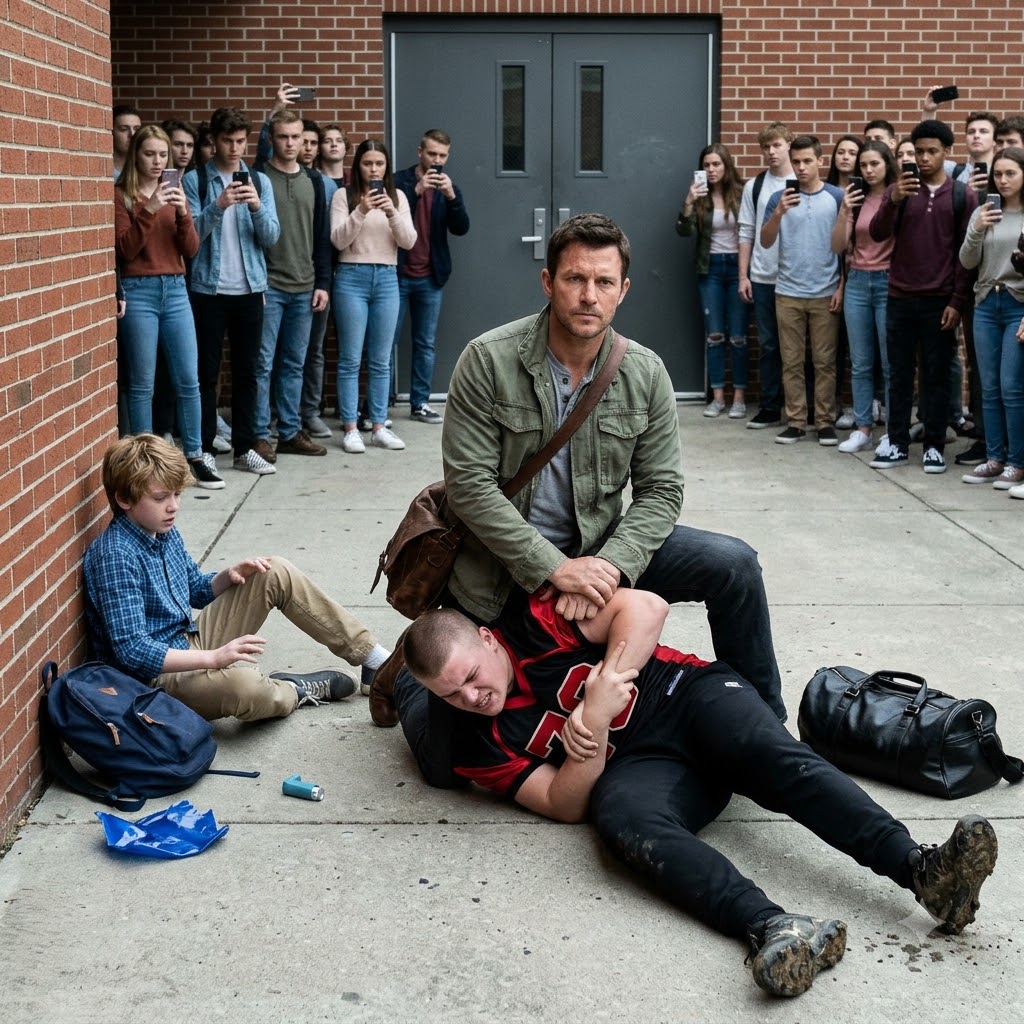
On Monday morning a substitute was leading my juniors through their essays. Higgins arranged a short call to update me. She did not disclose protected information from other students’ files, but she could say that several witnesses had come forward and the district was checking original recordings when supplied. The files did not all begin at the same moment. Some showed only my fall. At least one appeared to begin before the inhaler was crushed. Staff would verify that rather than promise a discovery they hadn’t yet made.
“An athlete who was nearby has given an account that conflicts with one of the visible sequences,” she said. “We’re asking him to clarify where he stood.”
“Which athlete?”
“I can’t discuss his identity with you right now.”
I was annoyed for half a second. Then I remembered the guidance not to press students for their statements. I nodded.
“My planner notes?” I asked.
“We’ve received them. They are relevant to understanding what you observed and when. We’ll also check whether anyone formally received earlier concerns. We can’t treat an entry you kept privately as proof that every adult knew.”
“Understood.”
Higgins looked tired. Not defeated, merely faced with the practical weight of a problem that should have been addressed in much smaller pieces. She had to protect Toby, hear Marcus, assess staff decisions, preserve evidence and manage a school where half the parents seemed to have opinions before the first review meeting was held.
“There is another issue,” she said. “Coach Miller has asked athletic administration to clear Marcus for team practice pending the full review. Our initial safety assessment has not been completed.”
“Did he get his way?”
“No determination has been made. That’s why the process exists.”
I sat quietly with the answer. It wasn’t the dramatic reversal I might once have craved. It was a boundary, held for the moment by people I had been too ready to dismiss. I thanked her and ended the call.
At lunch, Naomi came by with soup from the bakery downstairs. While she was cutting bread, she showed me a message forwarded from a staff representative. The football program had sent an internal request arguing that Marcus’s return to practice was essential to team preparation and that waiting for the standard safety review could harm his opportunities. The request had been referred upward rather than approved. No one outside the authorized staff was meant to receive the message, so I did not keep a copy or circulate it. I simply noted what Naomi was permitted to summarize and asked that any concern be handled through the proper channels.
“He thinks everything will go back to normal if the team keeps moving,” she said.
“For him, normal means no one can stop Marcus.”
“Maybe normal has finally become the issue.”
I thought about that as she left. I had once believed the worst thing that could happen to me was being knocked down in public. Now I could see a harder possibility: a school might follow every visible procedure and still quietly return to the habits that made Toby vulnerable. My account had been filed. The dates in my planner existed. Students were deciding whether to trust adults with their recordings. Nothing had been settled.
Then an email arrived asking me to attend a formal conduct review about my whisper, apart from the hearing on Marcus’s actions. At the same time, the athletics office confirmed that Coach Miller was continuing to press for practice access before the interim assessment was complete.
I read both notices on the same screen. Marcus’s future was being defended with remarkable energy. Mine was now under examination. For the first time since I’d stood up in the courtyard, I wondered whether telling the whole truth had given the people who protected him exactly the opening they needed.
By Tuesday the school had learned a fact that no one could see from the most widely shared clip: it had started recording too late.
That should not have been a revelation. We all knew different people had raised their phones at different moments. But the popular clip, viewed tens of thousands of times around town, began with Marcus’s punch. Its caption called the event a fight between a football player and a teacher. A fight requires at least two participants taking part. In that recording, one man threw a punch and the other fell, yet the caption had already supplied a second aggressor.
Higgins did not call me to announce that the internet was wrong. Instead, the district invited me to a scheduled evidence interview, with my workplace representative included if I wanted. My physician had restricted my activity but permitted limited participation from home. I set a chair near the desk, arranged the papers I needed and promised myself I would not turn discomfort into an excuse for losing patience.
The student-services director explained that some families had voluntarily submitted original video files. The school had recorded who supplied each file, what device it came from as reported by its owner, and whether it had passed through an app that might alter the timing. Two submissions covered different sections of the courtyard; one was longer than the clips being forwarded online. Their usefulness lay in their overlap and their limits, not in any magical view through walls.
I was allowed to see the portions relevant to my conduct and injury, with unrelated students’ identifying details minimized where possible. The first video showed Marcus holding the inhaler while Toby reached for it. I heard myself ask for its return. Then the filmer turned toward someone calling out beyond the frame, and the image shook. It did not prove how the inhaler had initially been taken. The second showed the inhaler falling by Marcus’s right foot and his cleat crushing it. It had begun too late to capture Toby’s first request. The third caught the punch and most of my fall but lost Marcus for a moment as the crowd surged.





