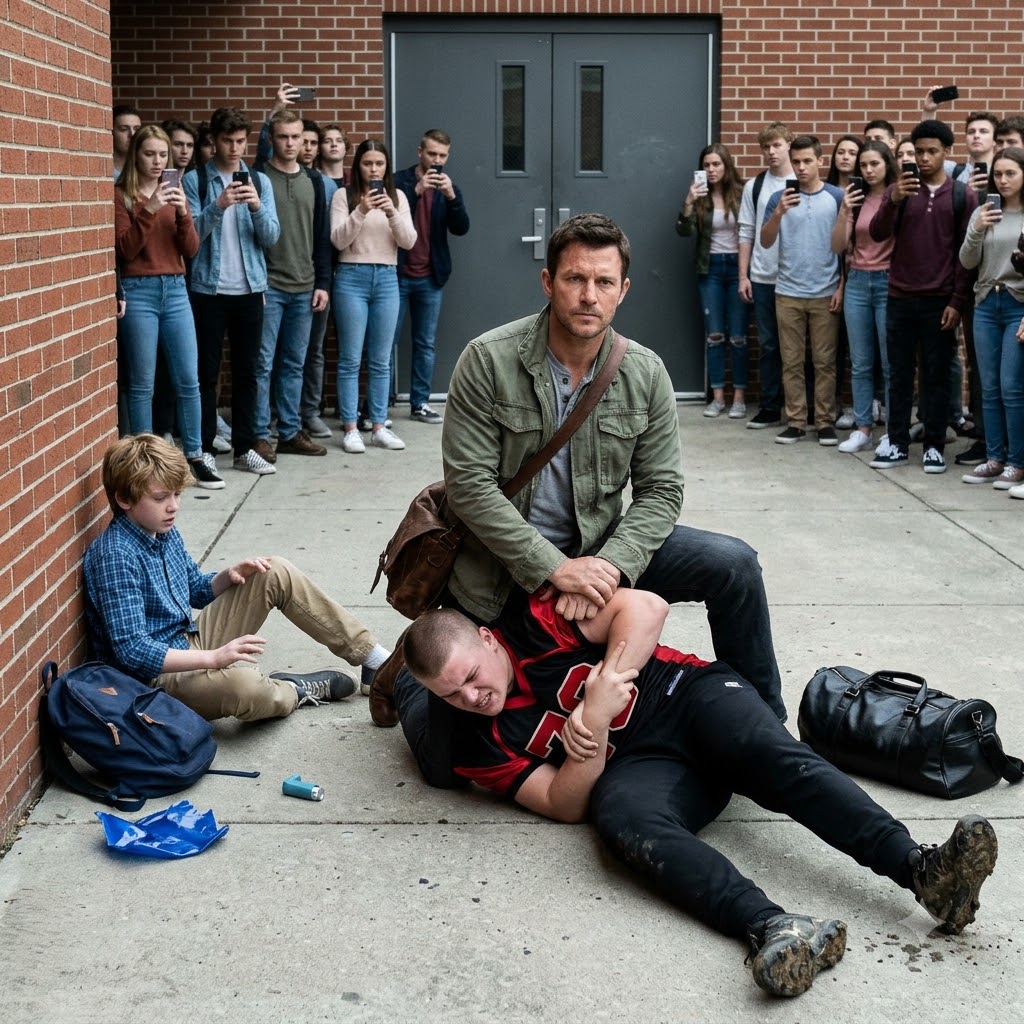
That sounded like the sort of instruction I might have given an overly helpful student. I sat on the nearest bench. From there I could see Toby taking more manageable breaths, though his shoulders still shook. His hoodie sleeve was pulled down over his hand. He had not looked at Marcus once since the nurse arrived.
A staff member photographed the broken inhaler where it lay before collecting it into a labeled envelope. I remember thinking that it looked absurdly small. Five minutes earlier a group of boys had used it to make another child feel powerless. Now it lay in fragments on concrete, and several adults were treating it with more care than Marcus had treated its owner.
“You need an ambulance too,” the nurse told me.
“I can stand.”
“That was not the question.”
I tried to laugh and stopped almost immediately. My chest did not approve. I gave her my name, the location of the injury, and what I remembered. I did not tell her about the whisper yet. Nobody had asked.
As the first responders took over, I saw Marcus beyond the benches with a faculty monitor beside him. He was talking rapidly, his hands moving with a kind of conviction. His teammates stood several yards away, suddenly fascinated by their shoes. The phones had not vanished; some students were watching their recordings, heads bent together.
I knew the story would leave the courtyard before we did. I did not yet know which version would arrive first.
At the hospital, the ceiling panels above my bed were the same gray-white as every other ceiling I had stared at after a fight. That resemblance bothered me more than the pain medication. I had spent seven years building a life in which medical professionals never had to ask who had hit me. Now a physician was studying images of my chest and explaining, gently, that I had two fractures on the left side. They were serious injuries that needed observation, pain management, breathing precautions and follow-up, not a challenge to endure stoically.
“You should tell us if your breathing worsens,” she said. “Don’t assume it’s just the pain.”
“I won’t.”
She studied my face. “People who say that too quickly are usually the people I have to repeat it to.”
I considered telling her I had learned to be an excellent patient. That would have been a lie. I listened instead.
My phone, retrieved from the pocket of my cardigan, had accumulated messages. One was from a colleague offering to bring my bag home. Another said Toby’s guardian had arrived and that he was receiving medical care. I reread that one three times. There were no details about his condition beyond what the sender was authorized to share. I was relieved that somebody had understood the difference between a child needing care and a child becoming public property.
The fourth message came from Principal Higgins. She had been at a district meeting during lunch, thirty minutes away from the courtyard. She expressed concern and said that someone from the school would contact me for a factual account once I was well enough. She did not pretend to have seen what happened.
Then a colleague sent a screenshot of a social-media post.
STAR PLAYER SAYS TEACHER THREATENED HIS LIFE AFTER SCHOOLYARD FIGHT.
Underneath were comments from people who had not been there, arguing about whether a teacher had any right to get into an argument with a student twice his size. Somebody had uploaded a cropped video beginning with my collapse. Another had chosen a frame in which my hand was near Marcus’s chest as I stood. It looked, without context, like an advance rather than a decision not to throw a punch.
The whole sequence had taken less time than a student needed to read the first page of a quiz. It was already being made into competing stories.
I turned my phone face down and watched the curtain around the neighboring bed stir in the air conditioning. One of the dangers of a fight is how quickly it offers a simple story: one person is strong, another weak; one person wins, another loses. In Chicago, audiences had paid cash to watch that story repeat. There had been no official bouts, no polished records or public triumphs. We fought in rooms above closed businesses and in makeshift spaces where a man with a towel decided when the evening was finished. I had learned to read weight shifts and recognize a frightened man pretending not to be frightened. I had also learned to confuse the ability to injure someone with the ability to solve anything.
Leaving had been less cinematic than the stories people tell about redemption. There was no final champion to defeat, no handshake in the rain. I had walked out after watching a young fighter stare at his shaking hands while an older man counted the gate receipts. I remembered thinking that the boy might spend his whole life trying to explain what those hands had done. I recognized myself in him. I went home, washed out a split in my eyebrow, and began applying for the teaching qualifications I had once abandoned.
For years, every time somebody asked why I chose English, I gave a different harmless answer. I liked books. I liked clear writing. I liked the moment when a difficult passage began to make sense to a student. All of those things were true. They were simply not the whole truth. The classroom was the first place I had found where putting something difficult into words counted as progress rather than weakness.
I had promised myself never again to raise my hands in anger. In the courtyard I had kept that promise. I had also leaned toward an eighteen-year-old student’s ear and said something a teacher should not say. The words had arrived wearing the voice of the man I’d left behind.





