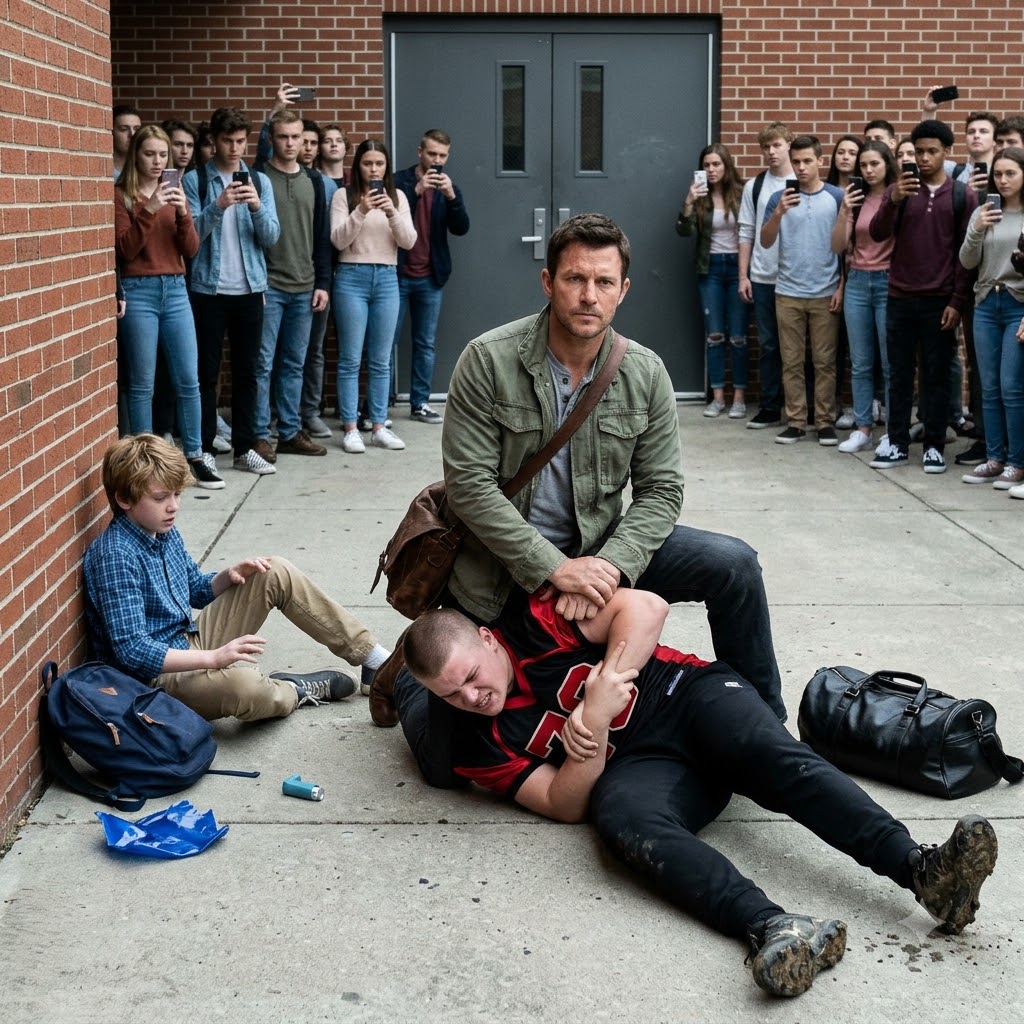
I thanked her and ended the call. It was the first time I’d been grateful for the delay between two envelopes. I needed a few minutes to accept the consequence for Marcus without turning it into a celebration of his suffering.
Outside my window a group of students passed on the sidewalk with backpacks bouncing against their coats. One laughed at a joke I couldn’t hear. I thought of Marcus as a freshman, before the big-game introductions and the local newspaper’s predictions. I did not know what he’d been like then. I knew only the young man I’d encountered and the actions now established. He would have to decide what sort of adult he wanted to become without leaning on the school’s applause.
The second letter arrived that afternoon. It was shorter than I’d expected. The district found that my language toward Marcus had been inappropriate and threatening, even given the injury and the urgency of the incident. I received a written professional warning and was required to participate in conduct counseling and a restorative workplace conversation focused on de-escalation, student safety and reporting. The finding acknowledged that I had not physically retaliated, had assisted in obtaining medical help and had given a complete account. It did not grant me an exception from professional standards because Marcus had acted far worse.
I read it twice, then called Naomi.
“A warning,” I said. “And counseling. I’ll be allowed to return when my doctor clears me.”
“How do you feel?”
“Relieved. Ashamed. Annoyed that the letter is right.”
“Those seem like reasonable starting points.”
“I used to think not hitting somebody was enough.”
“It’s important,” she said. “It’s not the only thing.”
I looked at the old scar along my thumb, one of the last visible souvenirs of Chicago. The skin had healed long before I’d learned to use that hand gently. I had treated my promise as a line I could never cross: fists stayed down, and therefore I had changed. The whisper showed there was another question. Could I resist using fear itself as a weapon, even when I had good reasons to be furious?
In the counseling session the following week, I did not offer excuses. The facilitator asked me to identify the moment when my decision-making had shifted away from Toby’s immediate safety. I told her it was when Marcus looked down at me and called me worthless. I had seen the crowd waiting for a response and allowed the memory of older fights to turn the scene into a contest of dominance. The realization was unpleasant. For an instant, after the punch, I had made the confrontation about my pride.
“What would you do differently?” she asked.
“Still intervene. Still get Toby help. Report everything. But I wouldn’t lean into Marcus’s ear to frighten him. I’d keep distance and direct staff to separate us.”
“Would you have been able to do all of that while injured?”
“Maybe not perfectly. I don’t want to invent a perfect version of myself. But I can learn what to aim for.”
She nodded. The conversation wasn’t a ceremony in which I proved I was good. It was practice for the next difficult day, which I hoped would be difficult in much smaller ways.
My ribs healed slowly. The first week had been about moving from bed to chair without cursing. The next was about recovering enough breath to speak a full paragraph without exhaustion. I followed the doctor’s advice, accepted rides, and learned to tolerate the humiliation of needing help with grocery bags. I was fortunate that my injury would improve. Toby’s experience had left wounds that a scan could not measure, and I refused to assume his return to school meant that all of them had vanished.
Through Higgins, with the family’s permission, I learned that Toby had returned to his classes. He had requested a quiet route near the gym during a few passing periods and later decided he no longer needed a staff escort for most of the day. The plan allowed him to change his mind. He had a replacement inhaler he could access, and school personnel knew what to do with the backup under the existing care plan. His guardian had met with the relevant staff and understood the reporting process. It was unglamorous, meticulous work. It was also what safety looked like when someone took it seriously.
A month after the assault, I went back to Oak Creek for the first full morning my doctor had approved. Autumn had turned colder. Yellow leaves lay packed against the curb, and a narrow ribbon of wind moved wrappers along the courtyard fence. I parked in the faculty lot and sat in my car for a moment, surprised that I was nervous about entering the building where I had spent so many uneventful mornings.
Naomi was waiting by the door with two paper cups of coffee. She handed me one, then gave me a look.
“You’re not putting that on a planter, are you?”
“Not planning to.”
“Progress.”
She walked beside me through the main hall, matching my slower pace without announcing that she was doing it. Students hurried toward lockers. Someone was arguing about a biology assignment. The morning announcements mentioned a canned-food drive and the winter concert. There were no cameras pointed at me and no crowd waiting to applaud my return. I felt unexpectedly grateful for that.
Higgins met me briefly before first period. We reviewed my work restrictions and the arrangements for classroom coverage if pain interrupted the day. She said that staff had received updated guidance about safety referrals, and that the district’s review of earlier handling was continuing. There was a reporting path for students, families and employees that did not require them to negotiate with a coach. It would not make the school perfect. It would make it harder to pretend nobody knew what to do.
“I also wanted to say thank you for cooperating with the process,” she said.





