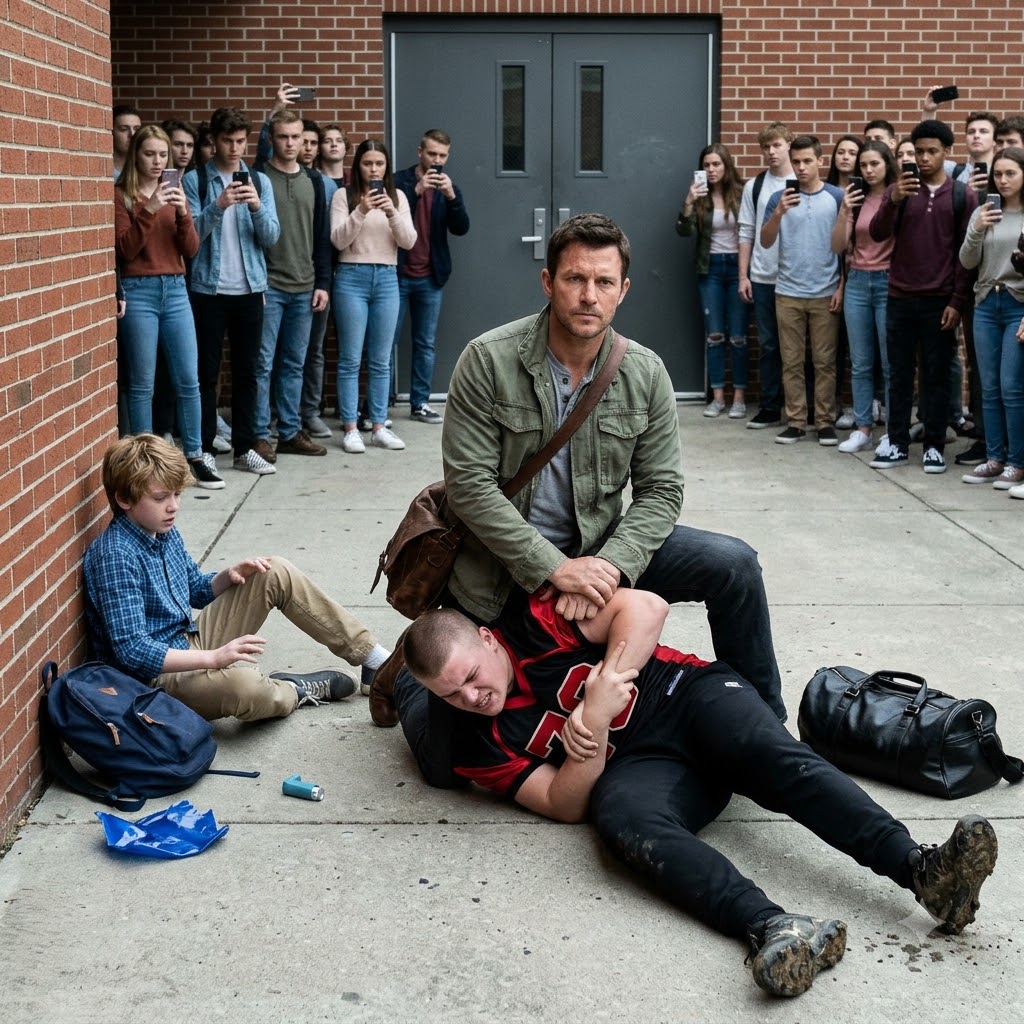
My phone buzzed with an update from the staff representative. One of Marcus’s teammates had amended his initial account after seeing a diagram of where the witnesses stood. He had originally said he’d watched my approach from directly beside Marcus. His own description of the benches placed him several yards away, partly behind other students when the punch occurred. He now acknowledged he had repeated part of Marcus’s version as if he’d witnessed it. That did not mean he lied about everything, and I was not entitled to his private interview. It meant the team had distinguished something he’d actually seen from something he’d been told.
I thought of the students who had filmed. At fourteen or seventeen, handing a file to adults could mean standing against the strongest person in your social circle. For some it might be simple. For others, particularly the players who had laughed while Toby struggled, the cost could be severe. They had responsibilities, but they were still young enough to be afraid. I wanted the school to make it possible to tell the truth without demanding public heroism from every witness.
I remembered a writing conference from the previous spring, when a junior had insisted that he was bad at essays because his memory always left things out. We had talked about the difference between memory and invention. A narrator could acknowledge an uncertain detail without surrendering the larger truth. In fact, the admission often made the rest more trustworthy. I wished I’d remembered that lesson when I first saw my own fall reduced to a clip. I’d immediately wanted the whole world to see exactly what I saw, as if the people holding phones had known how much I would later need them. They had been children watching a frightening event develop faster than they could understand it. Some filmed. Some called for help. Some froze. Their recollections would differ because their positions and decisions differed.
That night I wrote a short note to Higgins, not about the outcome I wanted, but about protection for students who volunteered information. I asked whether the district could communicate clearly that witnesses were not being recruited to take sides in a public fight and should not forward their classmates’ medical crisis around social media. I acknowledged that the school already had relevant guidance, and that the safety plan was not mine to design. The reply said student services had been discussing confidentiality and retaliation concerns with families. It was a modest answer. It also told me the adults were looking beyond the question of which camera proved what.
I closed my laptop before midnight. I could not control whether a teammate felt brave enough to speak, or whether a popular post would keep circulating after its claims were corrected. I could keep my own account precise, refuse to repeat unsourced claims and remember that the students whose names filled the review were people who still had to meet one another in the hall the following morning.
Friday brought the confirmation that the district would hold a formal review early the following week. The notice summarized the main allegations, the records to be considered, and the opportunity for Marcus, now legally eighteen, to respond and bring a supporter under the school’s procedures. It also noted the limits on sharing private student health information. There would be a separate professional-conduct discussion with me about my whispered statement. The procedures were fictional Oak Creek district rules, not a courtroom, and no one was promising a criminal judgment.
I studied the notice for a long time. The headline that had first spread through town had said a teacher threatened a promising athlete. Now the written issues included deprivation and destruction of a needed medical device, a physical assault, student safety, staff handling of reports, and my own inappropriate language. The list was heavier, less satisfying and much closer to the truth.
Later that day I joined one more short call with Higgins. She was preparing a chronology. I asked what she needed from me. She requested a clear account of where I had stood before and after the punch and confirmation that I had never heard the first exchange between Toby and Marcus. I answered both. Then, after a silence, she said Coach Miller had agreed to put in writing that he had dismissed earlier concerns as ordinary player disagreements. The statement would be reviewed alongside other accounts, not accepted as a universal explanation.
“That must have been difficult for him,” I said.
“I expect it was.”
“What changed his mind?”
“I can’t speak for his mind. We asked him to describe what he did.”
I smiled despite myself. The principal was a better editor than some of my juniors.
Before ending the call she added, “The review of your language will not be waived because you were injured, Mr. Vance. I wanted you to hear that clearly before the meeting.”
“I expected it.”
“And Marcus’s conduct won’t be excused because of your language.”
The two sentences belonged beside each other. Neither balanced the other out. They simply defined what each of us had done.
After the screen went dark, I opened the novel lying on my desk, but I didn’t read. I remembered Marcus’s face when I’d whispered. I had wanted him to imagine me tearing down his world through sheer force of will. Instead I now faced the possibility of losing the work that had given my own life shape. Tomorrow’s meeting would ask whether I could be trusted to speak to students after saying those words to one of them.





