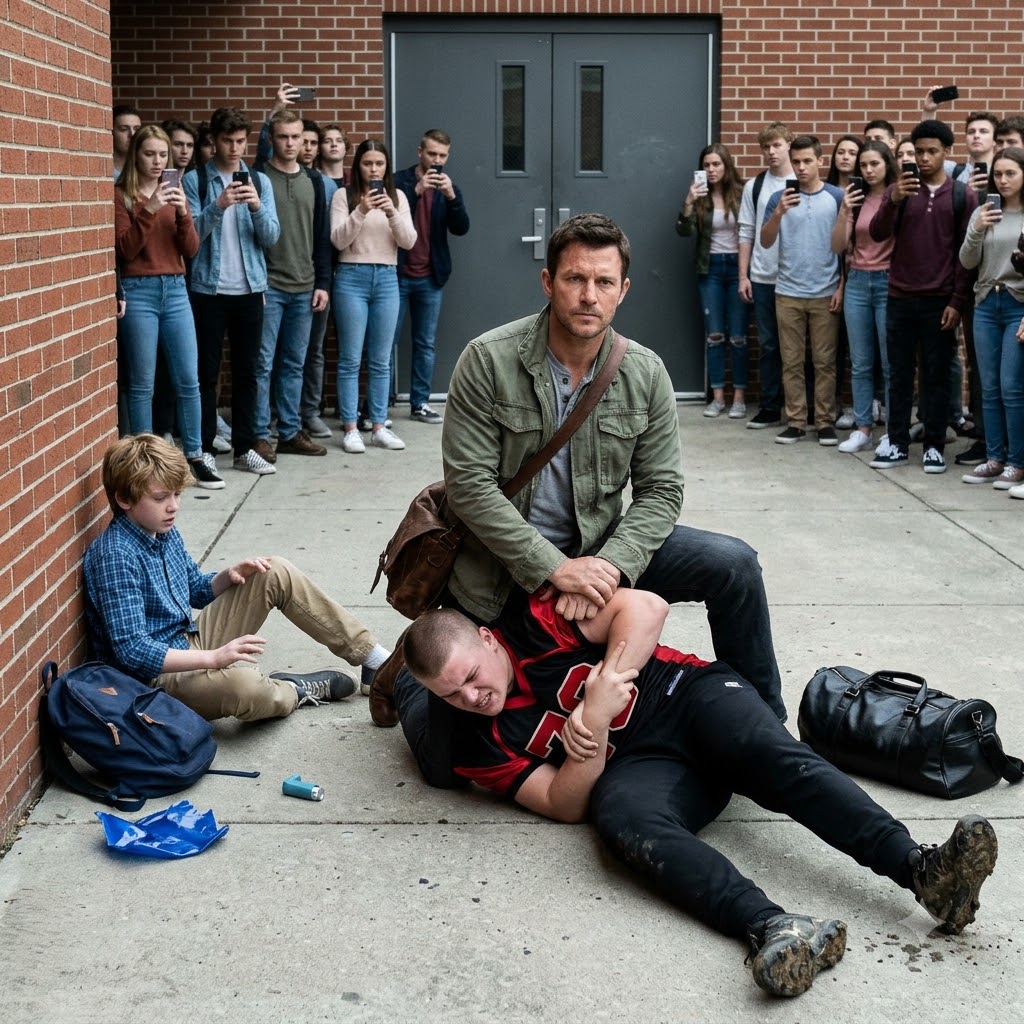
Friday evening brought the Oak Creek game. I knew it because the stadium lights reached the sky beyond my apartment window and because a low, distant roar drifted through town whenever the home team scored. For years I had treated the sound as harmless background. Now it made me think of Toby watching the campus from the far side of the same athletic building where he had nearly lost his breath.
A story about the incident appeared on a local discussion page. It was written without names but identified the school and invited readers to choose sides. The comments grew longer than the report itself. Some insisted a teenager couldn’t possibly have injured a grown man badly with one punch. Others said no teacher should ever confront an athlete. One claimed that Toby had been playing a prank. The author cited no witness for that last assertion. I took a screenshot for my own record and stopped reading. I could not cross-examine a rumor into becoming a fact.
What worried me more was the way adults were describing Toby. They called him “the asthma kid,” as though a medical condition were the entirety of his personality. I remembered him in my room at the start of the school year, when the freshman English class had visited our floor to hear older students read from their work. Toby had lingered by a display of handmade book covers and asked, through a stutter he appeared more annoyed by than ashamed of, whether the library had any mysteries with unreliable narrators. He liked finding out which facts a storyteller kept hidden. There had been delight in the question. He deserved to be remembered for that as surely as for the red hoodie he’d worn yesterday.
I went through the get-well cards. They contained the usual jokes about homework and substitute teachers. One student had written, You taught us to ask who gets to tell the story. Beneath it, another had added, Please don’t make us analyze this sentence when you get back. I smiled, then put the cards away. Their affection was not evidence. It was something else I wanted to protect: the ordinary trust that made a classroom possible.
Around eight, my phone rang from an unfamiliar number. I almost let it go to voicemail. The caller identified himself as Coach Miller.
“Vance,” he said, as though we were beginning a conversation already in progress. “I heard you’re hurt. That’s rough.”
“I’m following medical advice.”
“Good. Good. Listen, things got out of hand yesterday. Kids do stupid things when everybody’s filming.”
I waited.
“Marcus tells me you came right up into his space. Said something pretty serious. I’m sure there are misunderstandings all around.”
“I’ve submitted my full account to the school,” I said.
“Sure. But a young man can lose everything over one bad minute. You know how it is with recruitment. People remember headlines.”
He spoke as if my broken ribs were an unfortunate weather event and the future belonged exclusively to the boy who had thrown the punch. The easy response would have been anger. I concentrated instead on what he was actually asking.
“What would you like me to do, Coach?”
“Help everybody bring the temperature down. Say it was a confrontation that got physical. Leave the inflammatory details to the administration. There’s no reason this should follow Marcus forever.”
“He destroyed Toby’s inhaler. Then he hit me. Both belong in the record.”
“Nobody’s saying the inhaler was a good idea. I’m saying there are ways to handle things inside a program without making them a public hanging.”
“The school is reviewing it. I’m not conducting a public campaign.”
There was a pause. He lowered his voice. “You could be facing questions too, after what you said.”
“I know. I included it in my report.”
For once he had no immediate answer. After we hung up, I wrote down the time, duration and substance of the conversation. I did not claim he’d offered a bribe or demanded I lie. He had asked me to frame the incident as mutual conflict and implied that my own words might expose me. Those were facts worth keeping in their proper proportions.
The following morning Naomi took me to a brief medical follow-up. I obeyed another set of instructions about rest and activity, then rode home past the school’s stadium. The gates were open and volunteers were collecting cups from the stands. A banner over the entrance declared that the team was a family. I had taught enough students whose families were complicated to know that the word did not guarantee kindness.
Naomi asked whether I wanted to talk about Miller’s call. I told her what he had said. She listened without interruption.
“You could tell Higgins,” she said.
“I will. Exact words, as best I remember.”
“And then?”
“Then I let the people responsible for the review do their jobs.”
She gave me a sideways look. “You say that like it’s easy for you.”
“It isn’t.”
A teacher can spend years learning to manage a classroom and still feel helpless when control must be handed over to a process that doesn’t answer to him. I wanted a single decisive act: a telephone call, a confession, a picture held before a crowded room. But that desire was dangerously close to the fantasy Marcus had acted out in the courtyard. He had believed one punch could settle a question of authority. I did not want to replace his fist with my own theatrical gesture.





