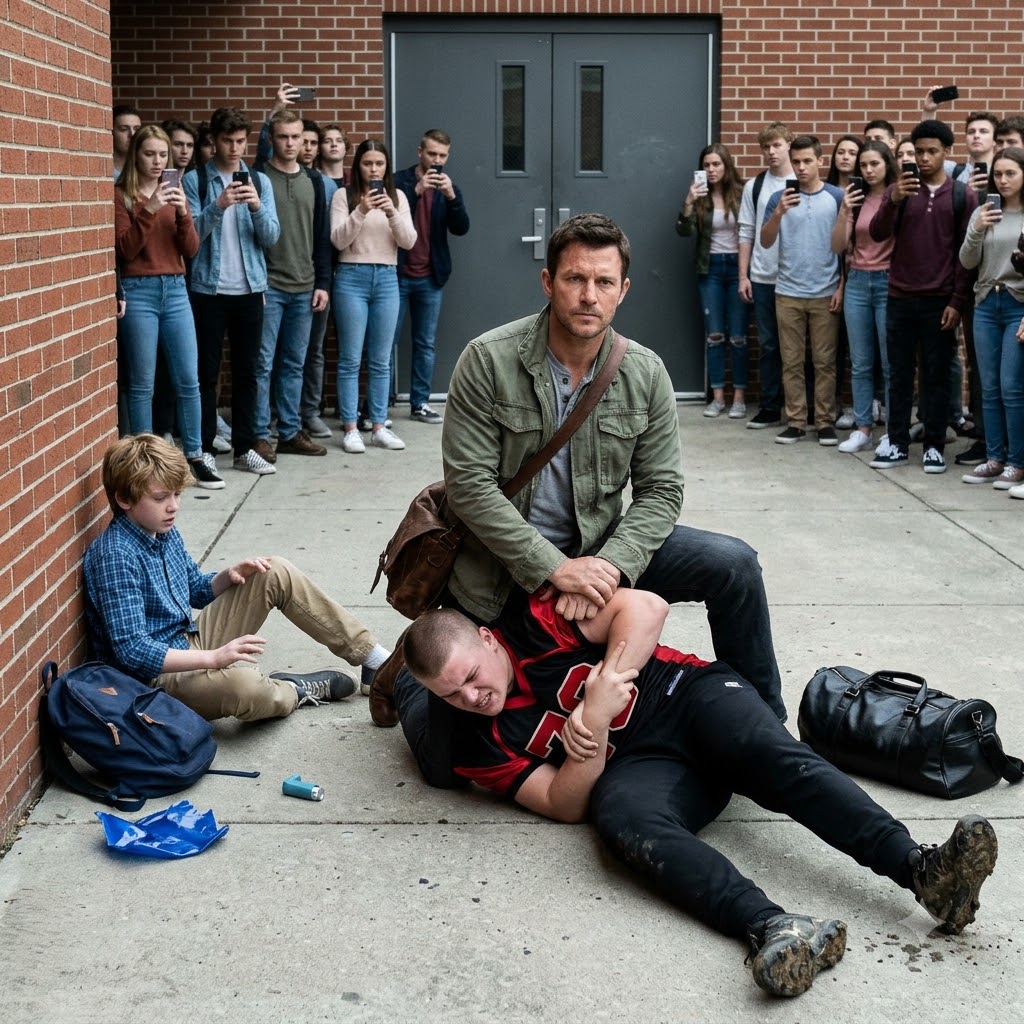
“I made it harder than it needed to be in one respect.”
“You acknowledged that. Now show your students what you learned. You don’t have to tell them private details. You can model how to handle being wrong.”
I went to my classroom. The familiar smell of dry-erase markers and old paper greeted me before the students did. My desk stood where it always had, and the books on the windowsill had been arranged in neat piles by the substitute. Someone had drawn a tiny cartoon coffee cup in the corner of the whiteboard with the words PLEASE STAY UPRIGHT underneath. I laughed and then regretted laughing too hard.
When the juniors arrived they were attentive in a way they never were for grammar exercises. A few asked about the injuries. I told them I was recovering and that the adults responsible had handled the incident. I would not discuss Toby’s medical details, Marcus’s private records or the review’s confidential material. The students seemed dissatisfied for about five seconds, then relieved to have limits they understood.
We returned to The Great Gatsby. I asked them to consider how people use wealth, status and admiration to protect themselves from the consequences of their choices. The class was quiet at first. Then a boy near the windows said, “People keep calling it an accident when the person has a lot to lose.”
Another student raised a hand. “But someone having a lot to lose doesn’t mean they can’t learn from it.”
“Both observations deserve attention,” I said. “What in the text supports them?”
For the rest of the period we argued about sentences in a novel. Nobody threw a punch. Nobody needed to. I could feel the ordinary life I’d worked so hard to build returning, not as an escape from responsibility but as its daily practice.
At lunch I took the inside corridor rather than the courtyard. This was partly doctor’s advice; the wind made my chest tighten and the long walk tired me. Near the library I saw Toby standing beside a display of student artwork. He had on the same red hoodie, though a different shirt showed beneath it. He was talking to another freshman, pointing at a hand-drawn cover with evident enthusiasm. The friend left for class, and Toby turned. He recognized me before I could decide whether to approach.
“M-Mr. Vance,” he said.
“Hi, Toby. Good to see you.”
He looked briefly at my side. “You okay?”
“Getting better. Thank you for asking.”
There were a hundred questions I might have asked. I could have asked whether he was afraid of Marcus, whether the replacement inhaler worked properly, whether he had read the online comments. None belonged in a spontaneous hallway conversation. I let him choose whether we spoke further.
“I read a b-book you recommended,” he said. “The one with the narrator who d-doesn’t tell you everything.”
“Did you like it?”
“Mostly. I figured out the ending.”
“Before the last chapter?”
He nodded, pleased. “The narrator kept leaving out the same kind of detail.”
“That’s a useful thing to notice.”
He considered me for a moment. “Everybody acted like they k-knew what happened. But most of them didn’t even know me.”
I felt the sentence settle between us. It was not a request for rescue; it was an accurate description of what adults and students had done with his name.
“You’re right,” I said. “I’m sorry people talked about you as though the incident belonged to them.”
“I told them I don’t want to do an assembly about it.”
“You shouldn’t have to.”
“The counselor said I didn’t have to.”
“Good.”
He adjusted the strap of his backpack. “I might do something for the school paper later. Not about the inhaler. About books.”
“I’d like to read it.”
Toby smiled. We talked for another minute about unreliable narrators, then he headed toward the library. He did not thank me again. He did not give a speech about courage or forgiveness. He walked away carrying his own bag, toward a room he’d chosen. After weeks in which people discussed his safety and dignity, I was glad to see him spending his energy on a story he wanted to write.
I had one more difficult conversation before the semester ended, though it did not happen face-to-face with Marcus. At a scheduled staff meeting Higgins summarized the school’s response to the broader reporting problem without sharing confidential student details. There was a revised route for reporting repeated intimidation, follow-up expectations for adults who received concerns, and a separation between team management and school discipline. Coach Miller would remain responsible for coaching duties under oversight but no longer have the informal ability to steer conduct decisions away from review. His formal reprimand was a personnel matter, not a trophy the staff could pass around.
During questions, someone asked whether the changes meant the school had failed Toby. Higgins answered carefully. “We met his immediate medical needs after staff were notified. But prior concerns weren’t consistently escalated. We have to own that if we want the next student to be heard earlier.”
The room was quiet. I thought of my own planner: three dated entries, each accurate in its narrow way, none enough by itself to build a safe path for the boys involved. I had been waiting for the institution to become brave without making sure I’d given it the clear record it needed. That realization was not a reason to blame myself for Marcus’s fist. It was a reason to do my part differently.





