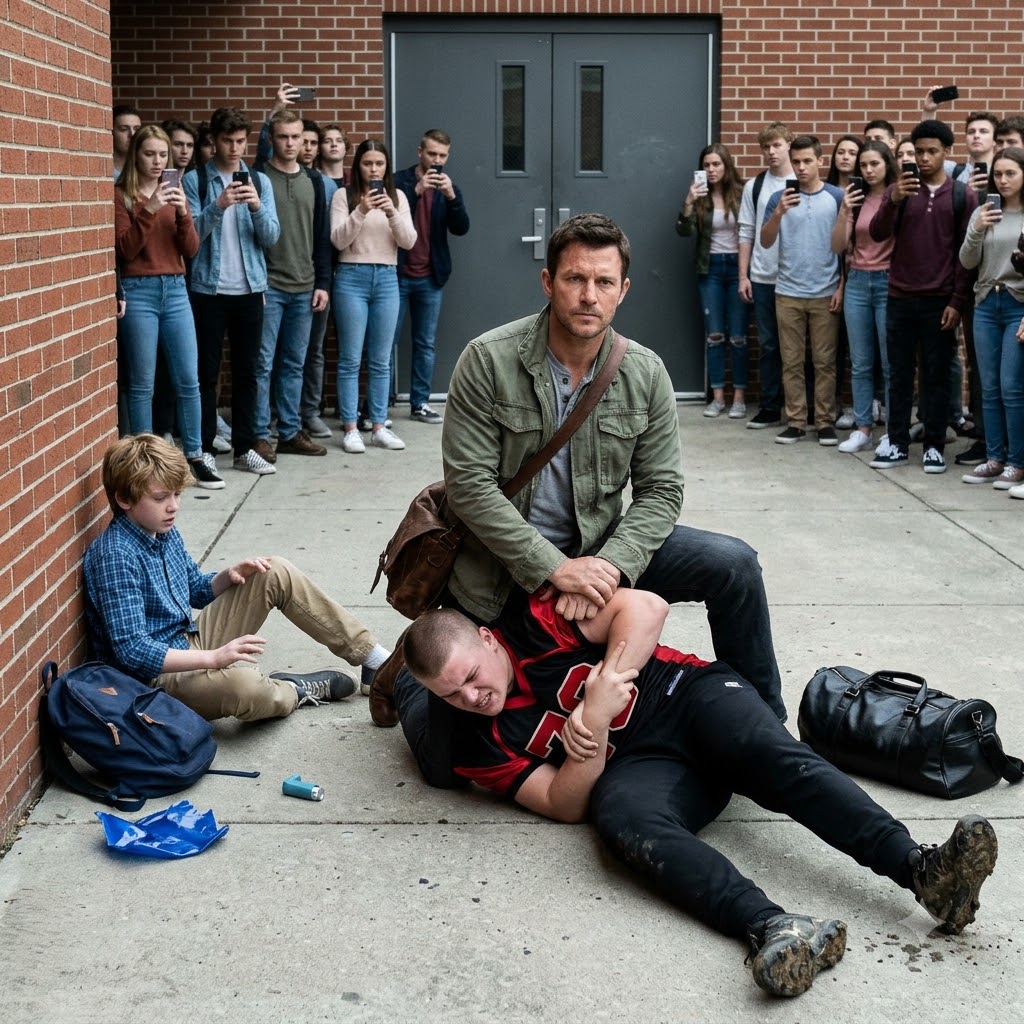
Before lunch, Higgins asked me to return for clarification on the evidence timeline. She explained that a confidential account from Toby would be considered with the guardian’s support. He had chosen to speak about the incident in his own words, including the effect of having his medication withheld. He did not wish to repeat his experience in front of Marcus or an audience of parents, and the process did not require such a spectacle. The panel would also review the nurse’s treatment record only to the extent needed for the school-safety finding.
I was grateful that Toby’s choice had changed the way the meeting was conducted. For the first time in the story the adults were telling about him, the freshman was not merely the smallest person in the courtyard. He was someone who could decide how his own voice would be heard.
A question came about the group of players. The panel had written statements describing the earlier keep-away. Some students admitted passing the inhaler. Others said they watched and laughed without touching it. One boy remembered Toby asking for it back before I arrived; another said he was too far away to hear the words. Nobody could supply a medical diagnosis from a glance across the yard. The difference between their accounts did not make all of them useless. In fact, the agreement on visible movements mattered more when the ordinary gaps were acknowledged.
The administrator displayed a simple diagram of the courtyard. The gym wall was on the left of the camera’s viewing direction, with Toby against it. Marcus stood near the center. My route from the planter entered from the right. The original clips had shown the inhaler changing hands before the final raised arm in one partial angle, and the stomp and assault in overlapping later views. No single video contained a neat, unbroken film from Toby’s first breath of trouble through my final word. That was not a deficiency the panel could fix with confidence alone.
The director asked one last question about my earlier observations. “Your September planner entries were written before the October assault. Did any student ask you to investigate an allegation further?”
“No one gave me a formal statement,” I said. “I intervened when I saw Marcus cornering students. The notes reflect that. I also made informal comments to staff, but I didn’t track them as reports.”
“Would you change that practice?”
“Yes. I’d make a formal referral when safety concerns recurred, and follow up with the affected students through appropriate channels.”
I realized as I answered that this was another kind of consequence. Marcus might not be the only person who had to do things differently when the meetings ended. I was learning that a moral intention wasn’t a substitute for an effective system.
By midafternoon the building was quieter. I stood carefully, walked the length of the corridor to ease the stiffness in my back, then returned to the chair beside Naomi. A poster on the wall advertised a district student-leadership initiative. The students in the photograph were all smiling at a table, each with a colored marker, as though the hardest part of collaboration were choosing who got the blue one. I wondered how many of them would know what to do if a friend stole another student’s medication. I knew how quickly fear could turn a witness into someone who looked away.
Naomi asked if I wanted to go home. I said I’d rather stay until my portion was finished. I did not say what I was really waiting for: a sentence that would make the uncertainty stop.
The administrator returned with several limited follow-up questions. The district had offered Marcus a chance to respond to the recordings, and he had disputed the claim that the stomp was deliberate. He said he was angry and careless and did not appreciate the medical significance of the object. He did not dispute that he’d dropped it and brought his cleat down on it. He also acknowledged striking me but claimed I’d been moving toward him aggressively. The panel was reviewing those accounts against the images and witness positions.
I did not get to hear his full presentation. I was told only the points relevant to my own statements, and I was given the opportunity to clarify, not to deliver a speech about his character.
“Can you describe where his foot landed?” the administrator asked.
“On the inhaler, where it fell beside his right shoe. I saw him look down before pressing.”
“Was it possible that he lost his balance?”
“I didn’t see him stumble. The footage may be more useful than my opinion.”
She nodded. I had learned, finally, not to improve a true observation by making it absolute.
As I waited again, I thought of my students’ debates about intention. In literature we often discuss what characters believe they are doing, but real people rarely hand us access to their minds. Marcus might have been furious at my challenge or afraid of looking weak before his teammates. He might genuinely have failed to think of the inhaler’s medical role until it was destroyed. None of those possibilities made the action harmless. But I did not want an official finding to depend on my ability to describe the contents of his head.
Miller passed us on the way to another room. He looked at my bandaged posture and seemed about to say something. Instead he walked on. A few minutes later I heard him speaking to a district employee in the corridor about the showcase. His voice rose slightly on the word “commitment.” The employee reminded him that eligibility decisions were separate from team preference and directed him back inside. I did not record the exchange as evidence. I was not meant to be eavesdropping. Still, the moment showed how deeply the same priority remained lodged in him.





